
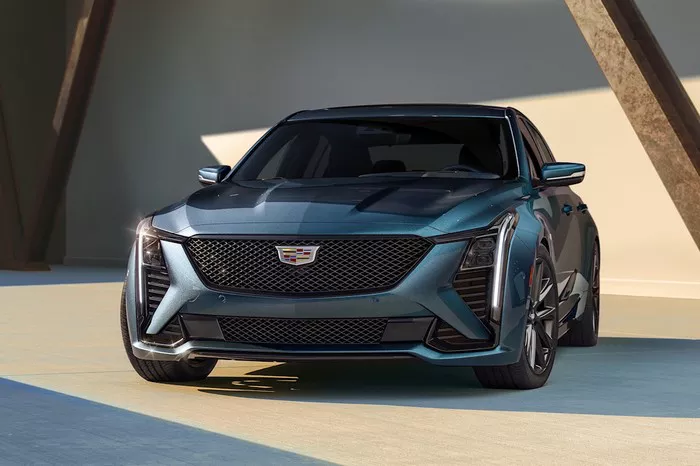
Cadillac has announced that its all-new VISTIQ electric SUV will officially debut on April 22, marking a significant expansion of the brand’s growing electric vehicle portfolio. The full-size model will become the third locally produced electric SUV under SAIC-GM Cadillac, slotting between the Lyriq and the larger Escalade IQ.
Built on General Motors’ Ultium platform, the VISTIQ enters the large SUV segment with a focus on space and versatility. The vehicle adopts a 2+2+2 six-seat configuration and features substantial proportions, measuring 5,222 mm in length, 2,026 mm in width and 1,799 mm in height, alongside a 3,094 mm wheelbase. It also offers 193 mm of ground clearance and a 19-degree approach angle, enabling limited off-road capability. Rear-wheel steering is included to enhance maneuverability and reduce turning radius, particularly in urban settings.
According to regulatory filings, the VISTIQ will be available with multiple powertrain options. A single-motor variant produces 255 kW, while a dual-motor configuration pairs a 183 kW front motor with a 260 kW rear motor, delivering a combined output of 443 kW. In its highest-performance form, the SUV is capable of accelerating from 0 to 100 km/h in under four seconds.
The model is equipped with a ternary lithium battery pack offering three CLTC-rated driving ranges of 573 km, 601 km and 642 km. Fast-charging capability enables the vehicle to regain approximately 127 km of range in just 10 minutes using DC charging.
On the technology side, Cadillac is introducing a hidden in-cabin LiDAR system on the VISTIQ, positioned along the upper inner edge of the front windshield. This design removes the need for external roof-mounted sensors while minimizing interference from environmental factors such as rain, snow and dust.
The VISTIQ also marks the debut of Momenta’s intelligent driving system in a Cadillac vehicle, enabling L2++ advanced driver assistance functions and navigation-assisted driving features, signaling the brand’s continued push toward more advanced autonomous capabilities.
