
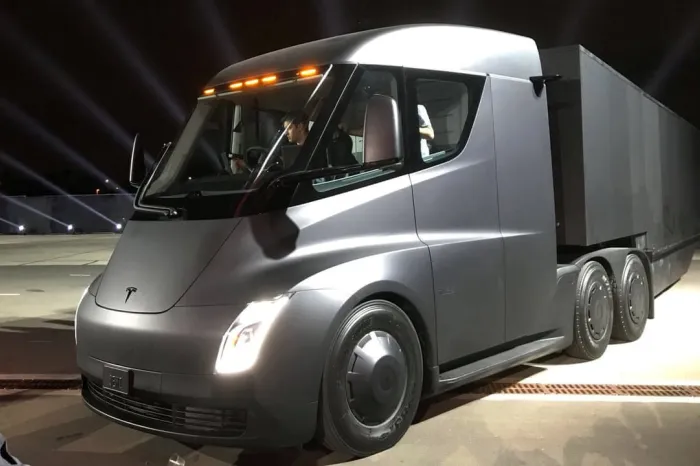
The electric truck market is witnessing renewed interest as Tesla prepares to ramp up production of its Semi, a Class 8 electric truck designed to revolutionize long-haul freight transportation. Originally unveiled in 2017, the Tesla Semi promised a range of up to 500 miles per charge, which would significantly reduce emissions and operating costs for the trucking industry, responsible for over 20% of U.S. transportation emissions. Despite delays pushing commercial production to 2026, the Semi is now positioned to challenge diesel trucks with its impressive range and faster charging capabilities.
Tesla’s Semi stands out from competitors by offering a longer driving range and megawatt-scale charging that can replenish up to 500 miles in about 30 to 40 minutes. This feature aligns well with mandatory rest breaks for truck drivers, making it practical for long-haul routes. Industry experts note that the driving experience in electric trucks like the Semi is more comfortable, with less noise, vibration, and no exhaust fumes compared to diesel trucks.
Real-world tests reinforce the economic benefits of electric trucks. A year-long study in Canada comparing diesel and electric Freightliner Cascadia trucks found that fleets could save nearly $160,000 per truck over six years due to lower fuel and maintenance costs. However, success depends heavily on adapting fleet operations to electric vehicles’ unique characteristics, such as route predictability and centralized terminals.
Despite these advantages, challenges remain, especially regarding charging infrastructure. While there are over 12,000 diesel refueling stations across the U.S., fewer than 100 megawatt-scale fast-charging stations exist for heavy-duty electric trucks, mostly concentrated in California. Building these high-capacity charging sites is costly and time-consuming due to power grid limitations and utility negotiations. Some companies are experimenting with solar-powered microgrids and battery storage to support charging demands.
Market conditions also affect electric truck adoption. The recent rollback of federal tax credits and emissions mandates has slowed investment in electrification efforts. Nevertheless, state-level incentives like California’s voucher program have driven strong demand for Tesla Semis, with hundreds of vouchers requested even before mass production began. Rising oil prices may further encourage fleets to consider electric options as they become more cost-competitive.
Tesla’s pricing strategy positions the Semi at around $290,000, lower than some competitors with shorter ranges but still higher than traditional diesel trucks. When combined with incentives, however, the total cost becomes more attractive. Industry observers remain cautiously optimistic that Tesla’s Semi could finally deliver on its promise to decarbonize heavy-duty trucking if infrastructure and policy support catch up.
In summary, while Tesla’s entry into the electric semi-truck market has faced delays and obstacles, its advanced technology offers a promising solution for reducing emissions in long-haul freight. The combination of extended range, fast charging, driver comfort, and potential cost savings may help accelerate the transition from diesel to electric trucks if challenges around infrastructure and policy are addressed.
