
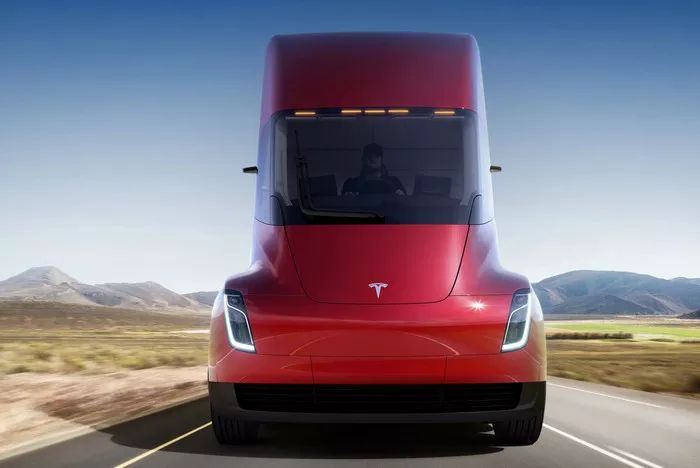
Tesla has officially opened its first publicly accessible Megacharger station for Semi truck customers in the U.S., a significant milestone for the company’s long-delayed electric truck program. Located at 4265 E Guasti Road in Ontario, California, the new charging hub is now available for Tesla Semi fleet operators, while two other existing Megacharger sites primarily serve Tesla’s internal fleet.
The Ontario station offers a current charging output of 750 kW, although Tesla’s Semi technology can theoretically support up to 1.2 megawatts, allowing for rapid replenishment of the truck’s 800-kilometre range. This launch marks the third Megacharger location in the U.S., joining the internal-only sites at Tesla’s Gigafactory in Nevada and in Carson, California, near the Port of Long Beach.
Tesla’s commitment to building a robust charging network for its Semi trucks is further evidenced by a recent update to its “Find Us” map, which now lists more than 60 planned Megacharger locations across 15 states. Combined with three existing megawatt-scale sites, the map reveals a network of 65 truck charging locations connecting major freight corridors from the West to the East Coast. Texas leads the expansion with 19 planned sites, followed closely by California with 17.
While many sites remain “coming soon,” insiders suggest a rapid rollout is underway. Dan Priestley, Head of the Tesla Semi Program, confirmed in April 2025 that 46 Megacharger stations are targeted for completion by early 2027, and Tesla’s Q4 financial report outlines 37 sites scheduled specifically for activation in 2026.
Further accelerating deployment, Tesla announced a partnership with Pilot Travel Centers in January 2026 to develop a proprietary truck charging network. Construction at selected Pilot locations in California, Georgia, Nevada, New Mexico, and Texas is expected to begin in the first half of the year, with the first hubs potentially opening by summer 2026. Each Pilot facility will feature four to eight V4 Megachargers capable of up to 1.2 MW, initially reserved exclusively for Tesla Semi trucks.
The Megacharger system leverages Tesla’s proprietary V4 technology, which combines decentralized satellite chargers with a separate Powerunit. At full capacity, it can restore most of a Semi truck’s 800-kilometre range in roughly 30 minutes. The technology also benefits Tesla’s passenger vehicle charging infrastructure, demonstrating versatility across the company’s lineup.
Infrastructure development signals that Tesla’s Semi, first unveiled in 2017 and long delayed, is finally nearing its U.S. launch. Production is set to take place at a dedicated facility adjacent to Gigafactory Nevada, with an anticipated annual output of 50,000 trucks. Tesla also plans to expand the Semi to Europe, the Middle East, and Africa (EMEA), with the vehicle drawing attention at the IAA in Hanover despite an expected market debut no earlier than 2026.
This first publicly accessible Megacharger not only represents a milestone for Tesla’s Semi program but also lays the groundwork for a nationwide charging network to support the future of electric freight in North America.
