
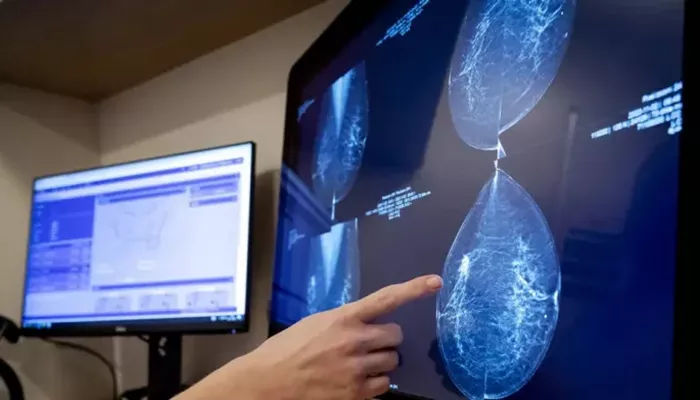
Every year, approximately 2.3 million new cases of breast cancer are diagnosed worldwide. According to the World Health Organization (WHO), the disease caused an estimated 670,000 deaths in 2022.
“Breast cancer remains the leading cause of cancer death in women, despite mammography screening,” said Christiane Kuhl, director of the Department of Diagnostic and Interventional Radiology at RWTH Aachen University Hospital.
“Mammography often fails to detect many cases early enough, especially fast-growing aggressive tumors, which are the most deadly,” she explained.
A new artificial intelligence (AI) model could change that. The algorithm can analyze mammogram images to accurately predict a woman’s risk of developing breast cancer within the next five years.
In a recent study, women classified as high-risk by the AI were four times more likely to develop breast cancer than those labeled as low-risk, Kuhl said. “This model allows us to predict the disease with far greater precision—even from mammograms that appear normal.”
Tailored Screening Could Replace One-Size-Fits-All Approach
In Germany, women aged 50 to 75 are offered mammograms every two years. But risk varies widely between individuals. Kuhl believes the “one-size-fits-all” model is outdated and advocates for personalized screening.
Dense breast tissue increases both the risk of disease and the likelihood that mammography will miss tumors. In the U.S., women are routinely informed about breast density and the associated “masking risk,” which can hide cancers from mammograms.
For women with very dense tissue, MRI (magnetic resonance imaging) is recommended. MRI produces highly detailed images without X-rays, but it is more expensive than mammography or ultrasound.
Clairity Breast AI Identifies Who Needs MRI
To better target early detection, the Clairity Consortium—an international network of 46 research institutions—developed the “Clairity Breast” AI model. It was trained on over 420,000 mammograms from Europe and the Americas.
Unlike traditional risk models, the AI does not require data on family history, genetics, or lifestyle. It evaluates mammograms to calculate breast cancer probability and classifies women into risk categories. The model assesses both the amount and texture of glandular tissue, another risk factor.
“Only about 10% of women have extremely dense glandular tissue,” Kuhl said. “Most women diagnosed late have less dense tissue. What matters is that the AI can determine within seconds who should get an MRI.”
Earlier Screening for High-Risk Women
Most countries begin routine breast cancer screening at age 50, when risk rises significantly. Kuhl said the AI model could benefit younger women by identifying those at high risk of aggressive tumors.
Young women often have dense breast tissue, which makes early detection via mammography difficult. However, Kuhl does not recommend lowering the general screening age. Instead, she proposes a two-step approach: first, standard mammography; then, AI analysis to assess five-year risk. Women flagged as high-risk would be offered an MRI immediately, potentially bypassing the need for further mammograms.
“This approach could allow us to detect dangerous tumors earlier while using resources more efficiently,” Kuhl said.
Related topic:
