
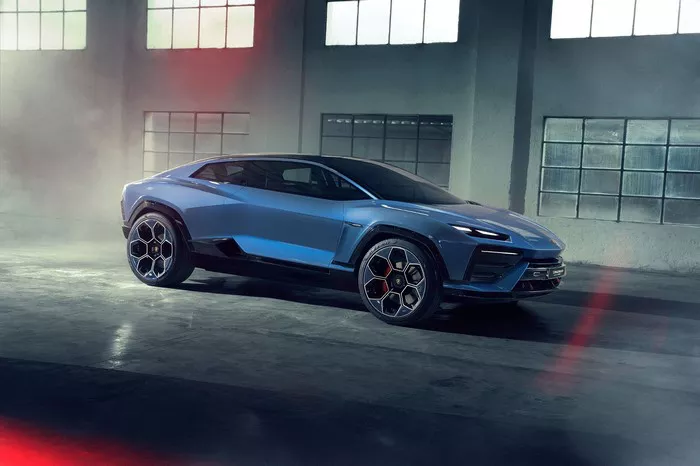
Lamborghini has announced it is canceling its highly anticipated all-electric Lanzador, citing minimal demand for battery-powered supercars among its clientele. In an interview with the Sunday Times, CEO Stephan Winkelmann confirmed the Italian automaker is now pivoting toward plug-in hybrid vehicles instead.
“The appeal of fully electric cars within our target market is close to zero,” Winkelmann said. Lamborghini’s decision follows extensive internal analysis, including discussions with customers, dealers, and market research. “Investing heavily in full-EV development when the market and customer base are not ready would be an expensive hobby, and financially irresponsible toward shareholders, customers, and employees,” he added.
The Lanzador, unveiled in 2023 as a 1,341-horsepower “Ultra GT” and Lamborghini’s fourth EV model, was slated for a 2029 release with an estimated $300,000 price tag. However, the company quietly retired the project at the end of 2025. Lamborghini did not respond to Fortune’s request for comment.
Lamborghini is not alone in scaling back EV ambitions. Volkswagen-owned Bentley postponed its electric-only target from 2030 to 2035, Porsche trimmed plans to build its own EV battery, and Ferrari reduced its fully electric sales goal from 40% to 20% by the end of the decade, though its all-electric Luce is still planned for 2028.
Other premium automakers have also faced setbacks. Stellantis, owner of Chrysler, Jeep, and Fiat, recorded a $26 billion EV write-down earlier this month. Ford similarly took a $19.5 billion hit in December 2025, scrapping the fully electric F-150 Lightning in favor of more affordable and hybrid vehicles. The company plans to launch a $30,000 EV pickup next year.
Despite setbacks for luxury brands, the overall EV market continues to grow. Benchmark Mineral Intelligence reported a 20% increase in EV registrations worldwide in 2025, including 33% growth in Europe and 17% in China, while North American sales dropped 4%.
Winkelmann explained that luxury EVs face challenges beyond macroeconomic conditions. Many customers miss the visceral experience of roaring internal combustion engines, a signature of high-performance cars. “EVs, in their current form, struggle to deliver this specific emotional connection,” he said. Hybrid models, in contrast, combine electric efficiency with the traditional appeal of gasoline-powered engines.
“Plug-in hybrids offer the best of both worlds, combining the agility and low-rev boost of electric battery technology with the emotion and power output of an internal combustion engine,” Winkelmann added.
Looking ahead, Lamborghini recognizes the inevitability of stricter environmental regulations. The U.K. plans to phase out new petrol and diesel cars by 2030, while the European Union mandates a 55% reduction in CO₂ emissions from new vehicles by the same year and bans new gas-powered cars by 2035. Lamborghini, classified as a small-volume manufacturer, is exempt until 2035 and argues its low annual mileage—fewer than 2,000 miles per car—limits its environmental impact.
By 2030, Winkelmann expects Lamborghini’s lineup to consist entirely of plug-in hybrid vehicles. He cautioned, however, that a fully electric Lamborghini is not off the table. “Never say never, but only when the time is right,” he said, emphasizing the need for the company to move quickly to maintain relevance in a rapidly evolving automotive industry.
