
Four centuries ago, the only solution for hearing loss was a large, funnel-shaped device known as the ear trumpet. While it was a simple mechanical tool that collected sound waves and directed them into the ear canal, its effectiveness was extremely limited.
It did little more than offer a slight amplification and was impossible to conceal for those who felt self-conscious about their hearing impairment. These devices were cumbersome symbols of a disability that lacked any real technological solution for centuries, setting the stage for a revolution that would require the advent of electricity to begin.
The Electrical Revolution and the First Portable Devices
The invention of the telephone directly paved the way for the first modern hearing aids. Thomas Edison, who personally experienced hearing loss, invented a carbon transmitter that amplified sound in his telephone. The electrical engineer Miller Reese Hutchison then utilized this same technology to create the first portable hearing aid, called the Akouphone, in 1898. This device marked a monumental shift from passive sound collection to active electrical amplification.
However, these early electronic aids were still large and impractical, consisting of a microphone, an amplifier, headphones, and very large batteries that lasted only a few hours. Vacuum tube technology in the 1920s and 1930s improved amplification, but users still had to carry a suitcase-sized box with a separate earpiece.
Miniaturization and the Move Toward Wearability
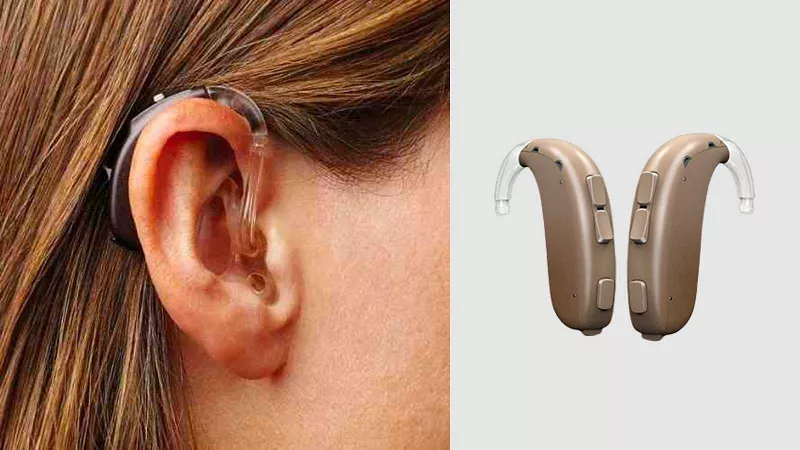
The invention of the transistor in 1948 was a critical turning point for hearing aid technology. Transistors were far smaller, more efficient, and more reliable than vacuum tubes, allowing engineers to design devices that were truly wearable for the first time. This era saw the development of behind-the-ear (BTE) and in-the-ear (ITE) models, making hearing aids less conspicuous and more integrated into daily life.
The introduction of the microprocessor in the 1970s was another leap forward, enabling hearing aids to divide sound into different frequencies. This allowed for more precise amplification of the specific sounds a person had difficulty hearing, laying the groundwork for digital processing.
The Digital Age and the Rise of Smart Features
The 1980s marked the beginning of the digital revolution for hearing aids. Digital technology converted sound into digital code, allowing for incredibly complex processing. This meant hearing aids could be programmed with extreme precision to match an individual’s unique hearing loss profile.
The 21st century has accelerated this trend, turning hearing aids into sophisticated mini-computers. They are now programmable, nearly invisible, and packed with advanced features. Digital processing enables sound to be automatically adjusted for different environments, filtering out wind noise and focusing on speech, which dramatically improves the user experience in challenging listening situations like restaurants.
Core Technologies Powering Modern Hearing Aids
A modern hearing aid operates through a sophisticated process. Sound enters through a microphone and is converted into digital signals by a computer chip. The chip analyzes and adjusts the sound based on the user’s hearing loss and the listening environment before converting it back into sound waves delivered by a tiny speaker called a receiver.
Key technologies enhancing this process include directional microphones that focus on sounds in front of the user and Bluetooth connectivity for wireless streaming from smartphones and televisions. Furthermore, features like telecoils (or T-coils) connect to compatible sound systems in public venues, providing clearer sound by reducing background noise.
Health Monitoring and Future Directions
Today, hearing aids are evolving beyond their primary function into multifunctional health devices. The latest innovations include “Healthables,” which are hearing aids equipped with sensors and artificial intelligence (AI). These devices can monitor physical activity, track steps, and even detect falls, alerting family members in an emergency.
While this advanced technology comes at a cost—often ranging from two thousand to seven thousand dollars a pair—the value proposition is significant. Modern aids with rechargeable batteries and long warranties represent a long-term investment in both hearing health and overall wellbeing, continuing a journey of innovation that started with a simple ear trumpet.
Related topics:
