
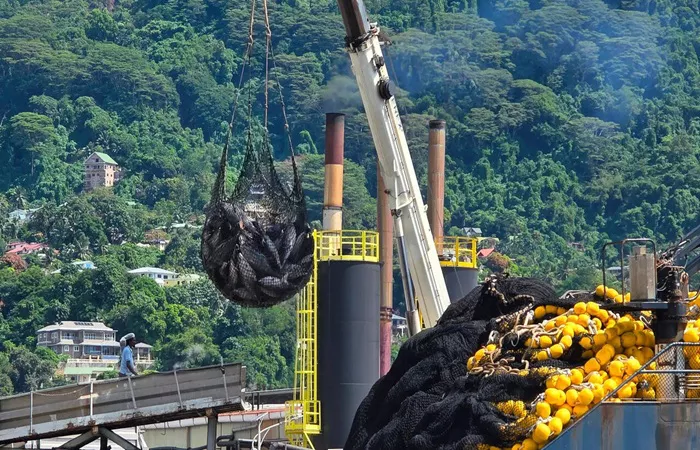
European fishing companies are increasingly registering their vessels under foreign flags to gain access to tuna quotas in the Indian Ocean, according to a new report by the Blue Marine Foundation and Kroll.
The practice, known as reflagging, allows European-owned ships to operate under the legal framework of countries including Mauritius, Tanzania, Seychelles, Kenya, and Oman.
The European fleet has long maintained a strong presence in the Indian Ocean, deploying large purse-seine vessels capable of carrying up to 1.8 million kilograms of tuna per trip. These vessels primarily target skipjack, yellowfin, and bigeye tuna, which are later processed and sold in global grocery markets.
Jess Rattle, head of investigations at the London-based environmental charity Blue Marine Foundation, highlighted the challenge of identifying true ownership. “We wanted to understand who really owned these vessels,” she said. “Were they owned by the coastal states whose quota they were now using, or in fact, by the EU?”
The report reveals that European companies are responsible for roughly one-third of the tropical tuna catch in the Indian Ocean. This is despite ongoing concerns about the sustainability of yellowfin and bigeye tuna stocks, which have faced mounting pressure in recent years.
Reflagging, while legal, complicates monitoring and enforcement. The use of multiple shell companies and foreign registries makes it difficult for regulators to track actual ownership, raising questions about transparency and the long-term sustainability of tuna fisheries.
The findings come ahead of the annual Indian Ocean Tuna Commission meeting in the Maldives, where the European Union and 28 member countries will review catch limits and management strategies. Observers say the EU faces a delicate balancing act: maintaining market access for its fishing fleet while meeting sustainability goals.
Related topics:
