
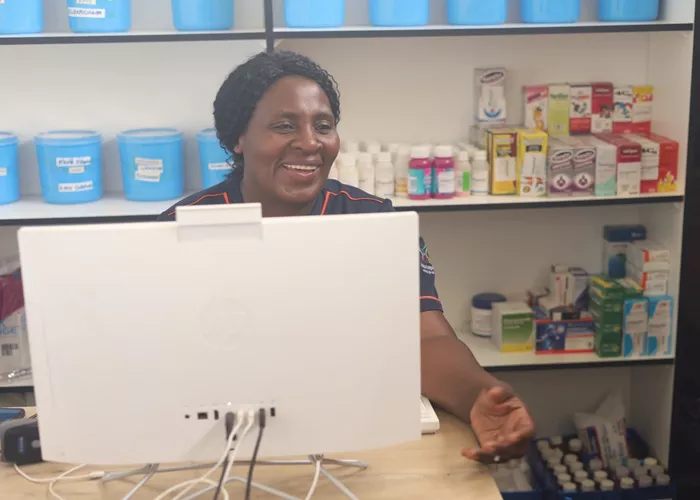
Elizabeth Ndadziona sits on a bench at the Hauna Post Office in eastern Zimbabwe’s Honde Valley, waiting for her turn at a small telehealth clinic tucked inside the building. The 42-year-old walked from Baradza, more than an hour’s drive north of Mutare, to refill her diabetes medication. Despite the distance, the Hauna Community Digital Health Center has become her most reliable access point to medical care.
The valley’s economy relies on tourism and agriculture, framed by tea estates and banana plantations. Though the post office’s walls are worn and fading, the facility remains a critical refuge—especially for women living with noncommunicable diseases (NCDs) like cardiovascular illnesses, cancer, chronic respiratory conditions and diabetes.
Globally, NCDs account for more than 70 percent of deaths, according to the World Health Organization. Their rise in countries like Zimbabwe is straining already weakened health systems. Women are disproportionately affected due to limited healthcare access and higher exposure to risk factors in low- and middle-income countries.
Telemedicine Steps In Where the System Falls Short
The Hauna center, opened in June 2024, is one of several facilities run by ZimSmart Villages, an initiative using technology to bridge Zimbabwe’s healthcare gaps. Telemedicine—remote consultations via phone or video—has quickly become a lifeline for rural communities.
Zimbabwe’s public health sector faces severe shortages of medicines and workers. Many nurses and doctors have migrated to the U.K. and U.S., leaving the country with a doctor-to-patient ratio of 1 to 5,000, and even worse numbers in rural regions.
Ndadziona remembers the onset of her symptoms. Hospitals were crowded, and securing a consultation took days. “I was thirsty all the time. I could drink more than two liters a day,” she said. Even after purchasing a glucose meter, she struggled to understand her condition. When her symptoms worsened in January, a friend referred her to the telehealth center.
Unreliable rural internet once made telemedicine nearly impossible. But with high-speed Starlink now available, ZimSmart Villages conducts smooth, real-time video consultations, giving rural patients access to care previously limited to cities. Women can walk in and receive medical attention within minutes—not hours or days.
Her initial worries about remote care quickly faded. “I talked to a doctor via video. A nurse administered an IV drip for a few hours. After two days, my blood sugar was normal,” she said.
As a farmer supporting two children, private care is out of reach. Telehealth consultations cost between $5 and $10, and medications are subsidized. She has since encouraged many others to seek help there.
Women Bear the Burden of Missed Care
Women in rural Zimbabwe face layered barriers: long distances to clinics, high costs and heavy caregiving roles at home. “Women often prioritize household needs over their own health,” said Dr. Admore Jokwiro, chief medical officer at ZimSmart Villages. “Hypertension and diabetes frequently go undiagnosed until complications arise.”
Of the 4,973 people screened at Hauna, 3,698 are women, said Alsandrah Kuvaoga, the organization’s business development manager. About 70 percent of women diagnosed with an NCD had never been screened before.
A System Built Around Access and Prevention
For women like Jessica Monzora, telemedicine has transformed care. She once waited a week at a local hospital for help managing high blood pressure. “When I heard about this initiative, I came immediately,” she said. A video consultation led to a change in medication, and her condition stabilized within days.
Nurse Memory Difura sees these improvements daily. After vital checks, she uploads patient data to the online platform for doctors to review. Prescriptions are issued electronically, and patients can buy medication on-site or at local pharmacies.
Beyond treatment, Difura conducts free diabetes screenings, cervical cancer checks, and provides health education on exercise, nutrition and breast self-exams. Women with chronic conditions are enrolled in remote monitoring programs, where nurses follow up through telehealth calls. “Many believe they are close to death when they’re diagnosed,” she said. “But the center is giving people hope.”
ZimSmart Villages also runs community health days and outreach events focused on prevention and early detection of diseases like hypertension, diabetes and cervical cancer.
Growing Infrastructure, Growing Expectations
Still, challenges remain. The telehealth center shares space with the post office, offering little privacy. “There is a need for a bigger space and a quiet room for rest,” Ndadziona said.
Jokwiro said expanded facilities are in the works. “Privacy and comfort are priorities in our next phase,” he noted. The program is also rolling out digital health promoters to allow women to receive screenings and consultations from home.
ZimSmart Villages has expanded from 17 to 28 centers since late 2024, screening more than 43,000 people. In Hauna, Ndadziona continues to monitor her sugar levels. “If it becomes high,” she said, “I will run to the center.”
Related topic:
