
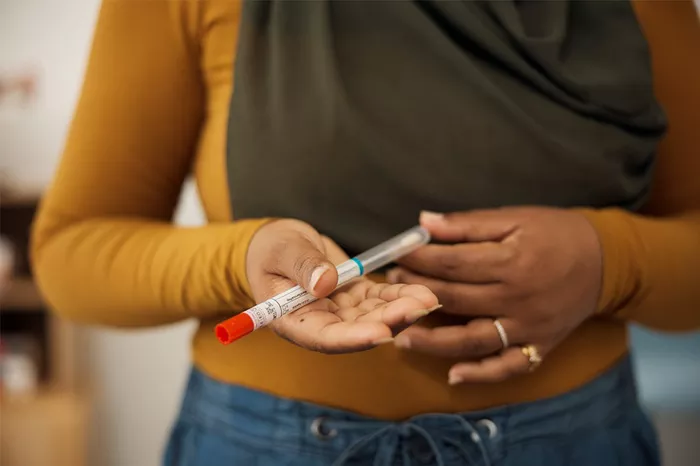
When Vaibhav Shitole moved to Ahmedabad for an MS in pharmaceutical sciences at the National Institute of Pharmaceutical Education and Research, he could hardly have imagined that a few years later he would co-develop M-Strip, India’s first patented cervical cancer screening test using menstrual blood.
After completing his MS in 2020, Shitole teamed up with IIT graduates Pradeep Kumar and Prasoon Kumar to launch IOTA Design and Innovations, focusing on frugal, technology-driven solutions in diagnostics. The company received Rs 65 lakh in funding from the Biotechnology Industry Research Assistance Council (BIRAC) to support early R&D.
“Our first project was a biosampler device,” Shitole explains. “Around 70% of India’s population lives in remote areas, where access to advanced diagnostic testing is limited. Samples often require costly cold storage and transport to Tier I or II cities.”
IOTA’s biosampler collects biological fluids such as blood, saliva, or urine and preserves them for up to seven days without refrigeration. Users can collect samples at home using a finger-prick device, which are then mailed to laboratories for testing.
From Biosampler to M-Strip
The Sterling Group approached IOTA to improve sample collection for HPV DNA testing, leading to M-Strip, a breakthrough in cervical cancer screening. Cervical cancer is the second most common cancer among Indian women, causing roughly 80,000 deaths annually. Yet it is highly preventable if detected early. HPV (human papillomavirus) is the primary cause, and the WHO recommends screening every three years. However, in India, fewer than 2% of women undergo regular screening.
Traditional cervical tests require a gynecologist to use a speculum to collect samples—a procedure many women find painful, invasive, or embarrassing. About half of women refuse the test due to discomfort or privacy concerns, Shitole says.
Research by Tata Memorial Centre and Stanford University suggested menstrual blood could detect HPV. Shitole’s team combined this insight with IOTA’s biosampler to create M-Strip—a simple strip women place on their sanitary pads to collect menstrual blood for lab testing.
Dr Somesh Chandra, former senior onco-surgeon at Sterling Hospital, co-developed the M-Strip concept with Shitole and Sterling Accuris Diagnostic. The test requires no medical professional, no invasive procedures, and no cold storage. Samples remain viable for analysis for up to 15 days.
Clinical Validation
A proof-of-concept study with 77 women showed 100% agreement with conventional cervical smear tests. A follow-up Clinical Trials Registry-approved study with 150 women confirmed the results. Some participants who tested negative with traditional methods tested positive with M-Strip, highlighting its accuracy, especially in rural or low-resource settings. Nearly 96% of women who tried both methods preferred M-Strip.
In 2022, Shitole formally founded IOTA Diagnostic Private Limited, with physicist Kaushik Chaudhary joining as co-founder. M-Strip received approval from the Central Drugs Standard Control Organisation in 2024 and was commercially launched four months ago. It holds an Indian patent, with global patents pending in the US and Europe.
Priced at Rs 1,800, the kit covers the test, pickup, report, and consultation. Samples are processed in IOTA’s NABL-accredited Ahmedabad lab, with plans to expand to Tier I cities for faster reporting. Institutional support comes from IIM Ahmedabad, the Department of Science and Technology, and the Gujarat government, alongside private investment.
Raising Awareness
While demand is growing, awareness remains a challenge. “Few women understand the importance of HPV screening,” Shitole notes. IOTA partners with doctors, uses social media campaigns, and engages media outlets to educate the public.
Shitole emphasizes that while HPV vaccination is effective, it is costly and limited in scope. Gardasil 9, which costs around Rs 25,000 for three doses, covers nine HPV variants, whereas 14 high-risk types contribute most to cervical cancer. For women beyond the vaccination age, regular screening with tools like M-Strip is critical.
IOTA is also partnering with the Tata Institute for Genetics and Society to expand the biosampler’s applications. Plans include collaboration with state governments, public-private partnerships, and corporate initiatives to scale cervical cancer screening nationwide—starting with Tier I cities such as Mumbai, Bengaluru, and Hyderabad, then expanding to Tier II and rural areas.
M-Strip represents a major step forward in making cervical cancer screening accessible, convenient, and reliable for women across India.
Related topic:
