
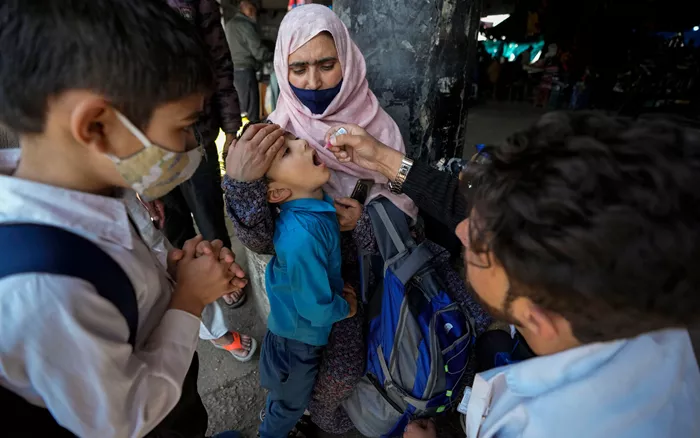
More than 14 million children remain unvaccinated worldwide, with conflict zones and healthcare mistrust blocking progress, according to new WHO and UNICEF data.
A new joint report by the World Health Organization (WHO) and the United Nations Children’s Fund (UNICEF) reveals that childhood vaccination rates have reached a worrying plateau. Despite small improvements, more than 14.3 million children worldwide received no vaccinations in 2024, while another 5.7 million were only partially vaccinated.
Public health experts describe the situation as hitting a “very stubborn glass ceiling,” particularly due to rising global conflicts and growing public distrust in vaccines and healthcare systems.
Children living in 26 countries affected by conflict or humanitarian crises are three times more likely to be unvaccinated than those in stable nations. Half of the world’s completely unvaccinated children live in these fragile settings.
The report identifies nine countries—Nigeria, India, Sudan, the Democratic Republic of Congo, Ethiopia, Indonesia, Yemen, Afghanistan, and Angola—as accounting for 52% of the world’s unvaccinated children.
While access remains the key challenge in low- and middle-income countries, vaccine hesitancy is the growing issue in wealthier nations.
Hidden gaps in national vaccine coverage can lead to outbreaks, O’Brien added, especially in communities where overall immunization rates appear high on paper but are low in certain groups.
This has already been seen in the United States, where a measles outbreak in low-vaccination areas of West Texas has spread, making 2025 the worst year for U.S. measles cases since the disease was declared eliminated in 2000. Over 90% of U.S. cases were in unvaccinated or status-unknown individuals, according to the CDC.
According to the report:
89% of infants worldwide received at least one dose of the DTP (diphtheria, tetanus, pertussis) vaccine, consistent with the past two years.
- 85% completed the full DTP series, up slightly from 84% in 2023.
- Measles vaccine coverage for the first dose remained at 84%, still below the 2019 level of 86%.
- Second-dose measles coverage increased to 76%, from 74% in 2023.
- Despite these small improvements, 20.6 million children missed their first measles shot in 2024.
HPV Vaccine Sees Encouraging Gains
One area of notable success is the HPV vaccine, which helps prevent cervical cancer.
- 31% of girls received their first dose in 2024, compared to 27% in 2023.
- Full series coverage among girls rose to 28%, from 21% the year before.
- Among boys, first-dose coverage held steady at 8%.
These gains were driven largely by new vaccination programs in Nigeria, Bangladesh, and several other countries.
“This is a bright spot,” said O’Brien. “We’re seeing meaningful year-on-year growth in HPV vaccine coverage.”
Dr. Dan Barouch, who directs the Center for Virology and Vaccine Research at Beth Israel Deaconess Medical Center, was not involved in the report but praised its findings. He stressed that even though childhood vaccination is among the most cost-effective public health interventions, too many children are still missing out.
“Fourteen million unvaccinated children is 14 million too many,” Barouch said. “We must prioritize funding and global efforts to protect every child.”
UNICEF’s Executive Director Catherine Russell echoed this call, urging immediate action.
“We must act now to overcome shrinking health budgets, fragile health systems, and misinformation. No child should die from a disease we can prevent.”
Related topics:
New Weekly Injection May Replace Daily Parkinson’s Pills
CDC Reports COVID-19 Cases Rising in 25 U.S. States
No Health Risk Found From Aluminum in Childhood Vaccines, Study Shows
