
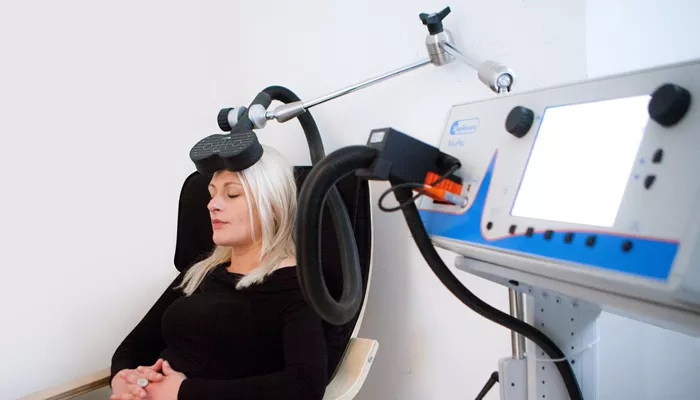
UMass Chan Medical School is one of four national sites participating in a Department of Defense-funded clinical trial testing a noninvasive, drug-free therapy for treatment-resistant postpartum depression.
The therapy, called SAINT neuromodulation, was developed by Magnus Medical and is FDA-cleared for major depressive disorder. In a previous double-blind study, nearly 80% of participants with major depression experienced rapid remission.
“The study data are very promising for a subset of women with severe depression,” said Kimberly A. Yonkers, MD, Katz Family Chair in Psychiatry and lead investigator at UMass Chan. “This therapy could provide relief for postpartum patients who have struggled to find effective treatment.”
Postpartum depression affects about one in eight women in the U.S., according to the Centers for Disease Control and Prevention. Symptoms can appear during pregnancy or in the months after childbirth. Current treatments, including antidepressants and psychotherapy, can take weeks to show results and may pose challenges for breastfeeding mothers.
“Postpartum depression can be devastating. A treatment that works in days rather than weeks could be life-changing for families,” Yonkers said.
SAINT therapy uses brain imaging to target mood-related regions for focused neurostimulation. Participants first undergo an MRI scan to identify individualized treatment targets. They then receive magnetic pulses in 10-minute sessions, 10 times per day, over five days in an outpatient setting. Responses may occur in a week or less, and ongoing treatments can continue alongside SAINT.
The multisite trial will enroll up to 192 women aged 18 to 45 diagnosed with a major depressive episode with peripartum onset—the technical term for postpartum depression. UMass Chan plans to enroll 85 participants.
Related topic:
