
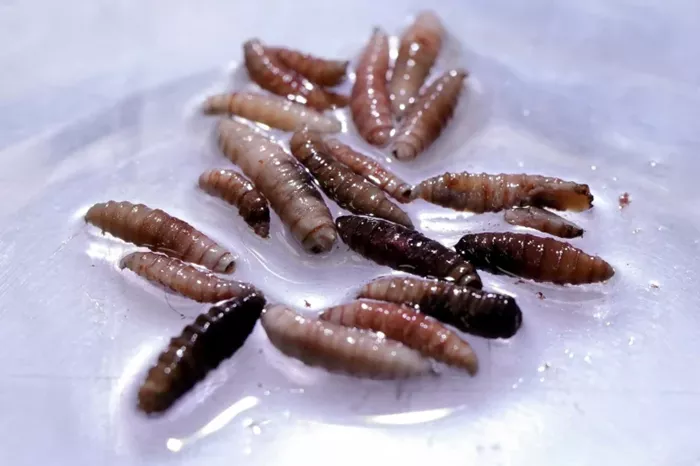
The United States has recorded its first human case of the flesh-eating New World screwworm parasite, federal health officials confirmed Monday.
The patient, a Maryland resident who had recently traveled to El Salvador, was diagnosed on August 4 after testing by the Centers for Disease Control and Prevention (CDC) and the Maryland Department of Health. Officials said the individual has since recovered, and there is no evidence of transmission to others or to animals.
“This is the first U.S. case of travel-associated New World screwworm myiasis detected from an outbreak-affected country,” said Department of Health and Human Services spokesperson Emily G. Hilliard. “The risk to public health in the United States from this introduction is very low.”
The screwworm parasite, the larval stage of the New World screwworm fly, can infest any warm-blooded animal. Once inside a host, the larvae burrow into tissue, causing severe damage and sometimes death. While human infections are rare and treatable, the parasite poses a grave threat to livestock, wildlife, and pets.
The U.S. eradicated screwworm in the 1960s using a sterile fly release program, but outbreaks have persisted in parts of Central America and the Caribbean. After costly campaigns in the 1980s and 1990s, the parasite has resurged in recent years, spreading northward through Mexico.
Agriculture Secretary Brooke L. Rollins announced a five-part plan earlier this month to counter the threat, including the aerial release of billions of sterilized screwworm flies over southern Texas and northern Mexico. Sterile males mate with females, but their eggs fail to hatch, gradually collapsing the parasite population. Officials warn, however, that the program may take two to three years to fully implement.
Texas leaders have raised alarm about the potential economic fallout. Gov. Greg Abbott noted that the state’s $867 billion agriculture industry, employing about 2 million workers, could be at risk. A U.S. Department of Agriculture report last year estimated an outbreak could cost Texas at least $1.8 billion in livestock deaths, labor, and treatment costs.
The screwworm fly, Cochliomyia hominivorax, remains endemic in Cuba, Haiti, the Dominican Republic, and parts of South America. Last month, Mexico reported a case in Veracruz, roughly 370 miles from the Texas border. In response, federal officials temporarily halted cattle trade across the border, repeating earlier emergency restrictions imposed in November and May.
READ MORE
RFK Jr.’s mRNA Funding Cuts Threaten Progress on Cancer Vaccines
FDA Halts U.S. Use of Ixchiq Chikungunya Vaccine
NIH Backs Whole-Virus Vaccines as Experts Question the Shift
