
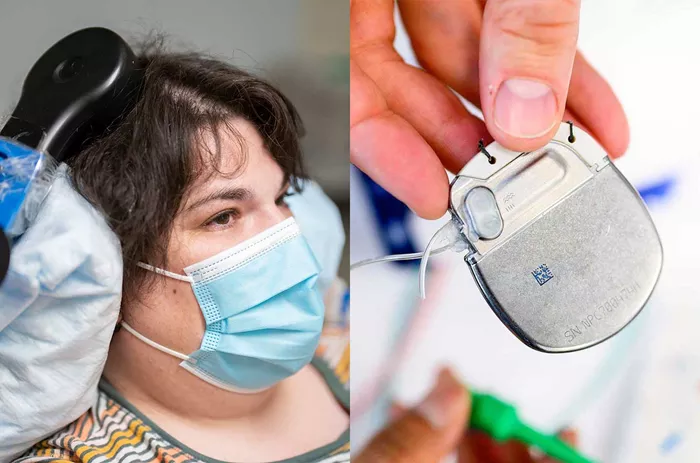
Deep brain stimulation (DBS) delivers targeted electrical currents through tiny electrodes implanted in the brain. Similar to a cardiac pacemaker, these pulses interrupt abnormal neural activity, stopping tremors or pain signals before they manifest. While continuous DBS has been used for decades to treat movement disorders like Parkinson’s disease, traditional systems often fell short in addressing patients’ evolving symptoms and were inconsistently effective for other conditions.
Over the past ten years, UCSF Neurological Surgery Professors Philip Starr, MD, PhD, and Edward Chang, MD, have pioneered surgical and brain-mapping techniques that enable personalized DBS. Their approach, developed in part at UCSF, allows electrical stimulation to be delivered only when abnormal brain activity associated with a patient’s symptoms is detected—a major departure from the “always-on” DBS devices of the past.
This innovation was supported by the NIH Brain Research Through Advancing Innovative Neurotechnologies (BRAIN) initiative. UCSF scientists are now demonstrating the transformative potential of adaptive DBS across Parkinson’s disease, chronic pain, depression, and obsessive-compulsive disorder (OCD).
Parkinson’s Disease
Shawn Connolly, a former professional skateboarder diagnosed with Parkinson’s disease at age 39, struggled with traditional continuous DBS that could not adjust to his fluctuating symptoms, eventually requiring a cane within five years. In 2021, he joined a clinical trial testing a self-adjusting DBS system developed by Starr and Simon Little, MBBS, PhD.
The next-generation device uses an algorithm to detect Parkinson’s-related brain signals and deliver electrical stimulation in real time, only as needed. Unlike earlier DBS, which was constantly active, this adaptive approach prevents tremors and rigidity precisely when symptoms arise.
In February, the FDA approved two similar adaptive DBS algorithms, one based on Little’s work, establishing the world’s first adaptive DBS system for Parkinson’s patients. Connolly describes the impact: “It’s definitely changed my life. I can just go through the whole day feeling good.”
UCSF researchers continue refining non-invasive methods to achieve similar personalized DBS outcomes without surgery, building on decades of NIH-supported work and techniques like electrocorticography, first used in a Parkinson’s patient in 2013.
Chronic Pain
Nearly a quarter of Americans suffer from chronic pain lasting three months or longer, often resistant to conventional treatments. In 2023, UCSF researchers, led by Prasad Shirvalkar, MD, PhD, used neural recordings and artificial intelligence to identify individual pain biomarkers—specific brain signals associated with the onset of pain.
This discovery has enabled clinical trials of personalized DBS systems that sense these biomarkers and deliver stimulation only when pain is imminent. By targeting the source in real time, researchers hope to overcome the limitations of traditional “always-on” DBS, which the brain could adapt to over time.
Depression
Treatment-resistant depression affects nearly one in three people with major depressive disorder in the U.S. UCSF’s Edward Chang and colleagues applied advanced brain mapping to identify neural activity linked to mood, discovering new stimulation targets.
In 2020, a patient named Sarah received personalized DBS, dramatically alleviating her depression. She reported that the device interrupts cycles of intrusive thoughts, complementing therapy and self-care techniques she learned at UCSF. Ongoing federally-funded trials aim to expand access to this approach to millions more.
Obsessive-Compulsive Disorder and Beyond
UCSF is one of a handful of centers offering continuous DBS for severe OCD, a condition affecting 1 in 50 Americans. NIH-funded research is now identifying neural biomarkers for OCD, opening the door to adaptive, personalized DBS treatments. Chang and his colleagues also envision expanding DBS for conditions such as addiction, Tourette syndrome, and Alzheimer’s disease, with therapies tailored to each patient’s unique neural signature.
“Tailoring these treatments to the person’s neural signature is really the key that allows DBS to be effective across many conditions,” Chang said.
Personalized DBS, once a concept, is rapidly evolving into a powerful tool with the potential to improve the lives of millions living with neurological and psychiatric disorders.
READ MORE
New Cumbria Hub Offers Same-Day Virtual Mental Health Care
New Initiative Improves Colonoscopy Experiences for Autistic Adults
Free Online therapy Anger Management Courses Offer Certificates
