
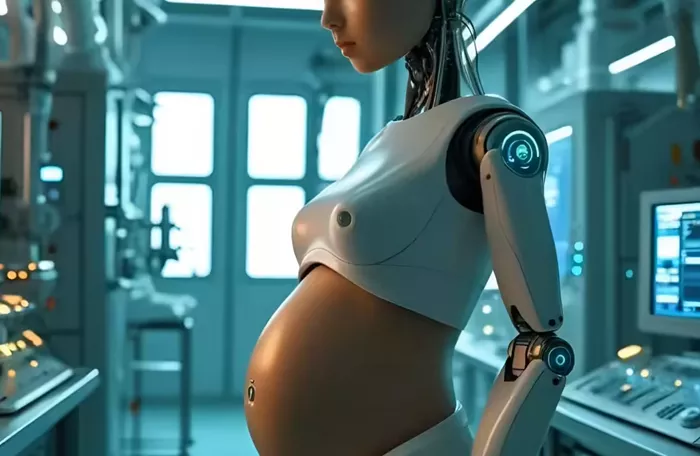
The project is led by Dr. Zhang Qifeng, a researcher at Nanyang Technological University in Singapore. Unlike neonatal incubators that support premature infants, this robot aims to replicate the entire gestational process—from conception to delivery.
Inside the machine, an artificial womb filled with amniotic fluid provides an environment for fetal growth. Nutrients are delivered through a tube resembling an umbilical cord, and the robot is designed to interact with humans, simulating a pregnancy in real time.
The idea builds on earlier research. In 2017, scientists at the Children’s Hospital of Philadelphia grew a premature lamb in a “biobag” for four weeks. The lamb developed wool and matured normally, proving gestation outside a biological womb is possible.
Dr. Zhang’s team now seeks to integrate similar systems into a humanoid robot capable of sustaining a full-term pregnancy. However, critical details—including fertilization and implantation methods—remain undisclosed.
Prototype and Policy Considerations
A working prototype could be unveiled within a year, with an estimated cost below 100,000 yuan (about $14,000 USD). Ethical and legal frameworks are already being discussed with officials in Guangdong Province to regulate use of the technology.
Mixed Reactions Online
The announcement has stirred intense debate across Chinese social media. On Weibo, the hashtag “World’s First Pregnancy Robot to Launch Within a Year” quickly trended, while a related Douyin video attracted thousands of comments.
Public responses ranged from excitement to skepticism:
“Where do the eggs come from?” asked one commenter, highlighting practical concerns.
Others welcomed the development: “It’s good that women don’t have to suffer,” and “Women have finally been liberated.”
For many experiencing infertility, the news struck a personal chord: “I tried artificial insemination three times and failed. Now I have a chance to have a baby.”
Still, some raised ethical concerns about whether artificial gestation could ever replace the experience of pregnancy and motherhood.
Rising Infertility in China
Infertility has become a growing health challenge in China. Rates increased from 11.9% in 2007 to 18% in 2020, according to data published in The BMJ. Major cities such as Beijing and Shanghai now include procedures like IVF and artificial insemination in public medical insurance, reflecting rising demand for fertility support.
The Bigger Picture
The pregnancy robot represents a potential milestone in reproductive technology, offering new possibilities for families facing infertility while sparking profound ethical debates.
For some, it symbolizes liberation from the physical and emotional burdens of conception. For others, it underscores the irreplaceable human bond forged during natural pregnancy.
As the technology advances, society faces a pivotal question: how to balance scientific innovation with the deeply personal meaning of parenthood.
YOU MAY ALSO LIKE
Mediterranean Diet Benefits Diverge by Gender, Global Study Finds
The Essential Nutrient Women Over 60 Often Miss, Say Experts
