
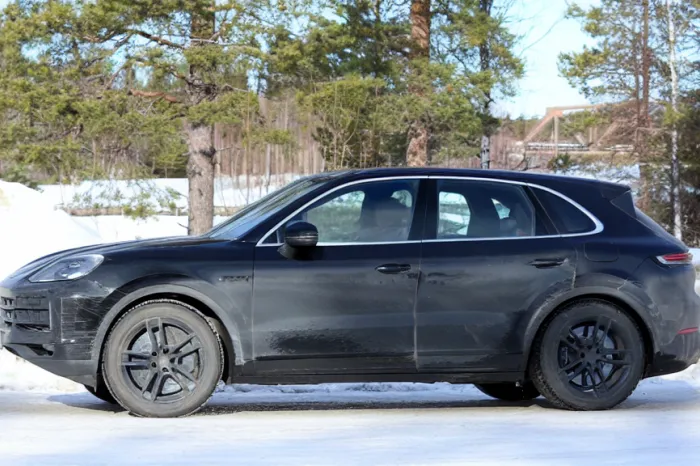
Porsche has officially confirmed that the next-generation Cayenne will continue to offer internal combustion engine options alongside electrified variants, with the new model expected to reach dealerships by 2029. This announcement marks a shift from the company’s earlier expectation that battery-electric vehicles would dominate its sales by 2030. Various factors, including customer preferences, rising development costs, and regulatory changes in Europe, have influenced Porsche’s decision to maintain internal combustion engines in its lineup beyond 2030.
Ralf Keller, the director of Porsche’s sport utility vehicle model lines, revealed that the upcoming Cayenne will be an all-new model replacing the current generation. While it remains possible for Porsche to further develop the existing MLB-Evo platform used by the current Cayenne, there is a strong likelihood that the new model will be built on the Premium Platform Combustion (PPC). This platform is a more advanced unibody architecture co-developed by Porsche and Audi and integrates both combustion and electric vehicle technologies.
The Premium Platform Combustion offers significant improvements over its predecessor, including faster infotainment systems, enhanced driver-assistance features, and better over-the-air update capabilities. Audi has already utilized this platform to push mild-hybrid technology further with its MHEV Plus system and improve plug-in hybrid models like the RS 5, which boasts a powerful twin-turbo V6 plug-in hybrid setup producing 630 horsepower. Porsche’s adoption of this platform signals similar advancements for the next Cayenne.
In addition to confirming internal combustion options, Porsche plans to redesign the Cayenne Coupe variant, which currently accounts for around 40 percent of global Cayenne sales and up to 60 percent in Europe. The new generation will continue offering V6 and V8 engines, but a four-cylinder option is unlikely. The V8 engine used in these models is assembled by Porsche in Zuffenhausen and is known as EA825 within the Volkswagen Group. This 4.0-liter twin-turbo V8 features a cross-plane design distinct from Lamborghini’s flat-plane V8 engine.
The shift to the Premium Platform Combustion aligns with Porsche’s strategy for other models as well. The next-generation Macan with an internal combustion engine is also expected to utilize this platform. Spy shots of a test vehicle resembling a modified Audi Q5 suggest that PPC will underpin multiple Volkswagen Group models moving forward.
Overall, Porsche’s confirmation of internal combustion engines in future Cayenne models demonstrates the company’s pragmatic approach amid changing market dynamics and regulatory environments. By leveraging advanced platforms like PPC, Porsche aims to deliver vehicles that balance performance, technology, and customer demand well into the next decade.
