
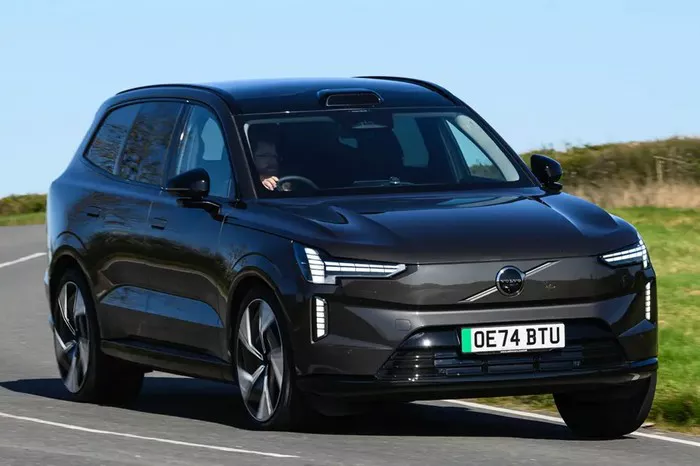
Volvo Cars has officially introduced two of its most significant electric vehicles in the Philippine market — the EX90 electric SUV and the ES90 electric sedan. The models were unveiled in Manila before the end of February by Hariphil Asia Resources Inc., marking one of the most notable premium EV launches in the country in recent months.
The arrival of these flagship electric models signals Volvo’s growing commitment to electrification in Southeast Asia and highlights the brand’s effort to bring its latest global technologies to Filipino consumers.
EX90 Leads Volvo’s Electric SUV Lineup
The Volvo EX90 represents the brand’s next-generation flagship SUV and serves as the electric successor to the widely recognized XC90. Built on a dedicated EV platform, the three-row SUV offers seating for up to seven passengers and features a spacious cabin enabled by a flat-floor design.
Under the hood, the EX90 is powered by a dual-motor all-wheel-drive system producing approximately 456 horsepower and 770 Nm of torque. Energy comes from a 111 kWh battery pack, which Volvo estimates can deliver a driving range of up to 600 kilometers under the WLTP standard.
The SUV also supports DC fast charging at speeds of up to 350 kW, allowing the battery to recharge from 10% to 80% in around 22 minutes under optimal conditions.
One of the EX90’s most advanced features is its roof-mounted lidar sensor, integrated into the vehicle’s safety and driver-assistance systems. Working alongside cameras, radar, and ultrasonic sensors, the lidar technology is designed to enhance situational awareness and represents a key step in Volvo’s development of next-generation autonomous driving capabilities.
In the Philippines, the Volvo EX90 Ultra BEV is priced starting at P5.99 million (about $101,400), positioning it firmly within the premium electric SUV segment.
ES90 Electric Sedan Focuses on Efficiency and Charging Speed
Alongside the EX90, Volvo also introduced the ES90 electric sedan, a model that brings a different set of technological advantages.
The ES90 is built on an 800-volt electrical architecture, a system typically found in high-performance EVs such as those from Porsche or Hyundai’s E-GMP platform. This design enables faster charging and improved overall efficiency.
Volvo estimates the ES90 can travel up to 700 kilometers on a full charge under WLTP testing, placing it among the longer-range electric sedans currently available. Aerodynamic efficiency also plays a role, with the car featuring a fastback profile and a drag coefficient of 0.25.
The front of the vehicle replaces the traditional grille with a closed fascia that integrates cameras and radar sensors for advanced driver-assistance systems.
Inside, the ES90 follows Volvo’s minimalist design approach, featuring a large central touchscreen, a digital instrument cluster, and limited physical controls — a layout increasingly common among premium electric vehicles.
The ES90 Ultra BEV enters the Philippine market with a starting price of P5.265 million (approximately $89,130), making it slightly more affordable than the EX90.
Premium EVs Set the Stage for Market Growth
Electric vehicle adoption in the Philippines remains in its early stages, with charging infrastructure still developing outside major urban areas such as Metro Manila. The market for high-end EVs also remains relatively small.
However, flagship launches like the EX90 and ES90 often play a key role in establishing brand presence and setting technological benchmarks before more affordable models enter the market.
Competing vehicles from Chinese manufacturers are also gaining attention, often offering feature-rich packages at lower prices. For example, Hongqi’s HS7 is available in the Philippines with prices ranging from P2.58 million to P3.50 million (around $42,500 to $59,250).
Looking ahead, Volvo is expected to introduce the smaller EX30 in the region, a model that could attract a broader range of buyers and contribute more significantly to sales volume.
For now, the launch of the EX90 and ES90 demonstrates that the latest global electric vehicle technology is steadily making its way to Southeast Asia, giving Philippine consumers earlier access to Volvo’s newest EV innovations.
