
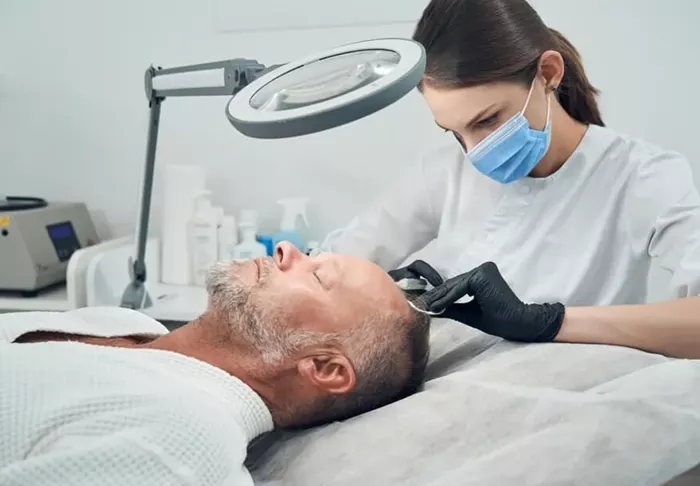
Walk through Istanbul Airport on any given day and a distinctive sight quickly emerges: men with shaved heads, freshly bandaged scalps, and the slightly dazed expression of someone recovering from hours-long surgery. They often travel in pairs or small groups, many wearing clinic-branded caps handed out upon discharge.
The image has become so familiar that a photograph of an airplane cabin filled with bandaged passengers—captioned “Turkish Hairlines” over the branding of a major international airline—went viral. The joke inspired a Spanish comedy film, countless TikTok videos, and a cultural shorthand for a booming form of medical tourism that shows no sign of slowing.
Istanbul now performs an extraordinary number of hair transplant procedures each day, anchored in a city that bridges Europe and Asia. While Europeans once made up the bulk of patients, a growing number of Americans are now booking flights across the Atlantic to join the queue.
A stark price divide
Cost remains the most powerful driver. In the United States, a hair transplant typically costs between $10,000 and $25,000, depending on location, surgeon reputation, and the number of grafts required. In major markets such as Los Angeles or New York, clinics often charge $8 to $12 per graft. A comprehensive procedure of around 4,000 grafts can easily exceed $30,000.
In Istanbul, the same procedure is commonly priced between $2,000 and $4,500—and that figure is usually all-inclusive. Packages often cover the surgery itself, hotel accommodations, airport transfers, a personal translator, medications, platelet-rich plasma (PRP) therapy, and months of follow-up support. Even after factoring in airfare, patients frequently report that treatment in Turkey costs a fraction of what they would pay at home.
The disparity is not simply the result of lower standards. Turkey’s healthcare cost structure differs significantly from that of the United States, with lower living costs, reduced insurance expenses, and less regulatory overhead. High patient volume also plays a major role. Leading clinics perform multiple procedures daily, allowing fixed costs to be spread across thousands of cases. Some prominent practices report operating dozens of surgical suites and treating patients from around the world for decades.
From early techniques to cutting-edge methods
Turkey’s rise to dominance has been years in the making. In the early 1980s, Brazilian dermatologist Dr. Carlos Uebel pioneered individual grafting techniques for male-pattern baldness and later expanded his work internationally, including into Turkey. Local plastic surgeons and dermatologists adopted these methods, refined them, and trained successive generations of specialists.
The turning point came with the widespread adoption of Follicular Unit Extraction (FUE). Unlike the older strip method—which involved removing a strip of scalp and left a linear scar—FUE extracts individual follicles through tiny circular incisions. The technique is associated with minimal visible scarring, faster recovery, and more natural-looking results. Turkish clinics embraced FUE early and at scale, helping cement the country’s reputation.
Innovation has continued. Sapphire FUE uses blades made from synthetic sapphire crystal to create narrower incision channels, potentially allowing denser implantation and quicker healing. Direct Hair Implantation (DHI) employs a specialized pen to extract and implant follicles simultaneously, offering greater control over angle and direction.
Government policy also played a role. In 2011, Turkey’s Ministry of Health launched initiatives to promote medical tourism, streamline visa processes, and set facility standards. Expanded global airline networks further improved access, making Istanbul a practical destination from nearly any major city.
Professional athletes were among the early adopters, quietly traveling to Istanbul for procedures and later appearing with noticeably fuller hair—fueling word-of-mouth interest worldwide.
Why Americans are now on board
For years, Turkey’s hair transplant industry catered mainly to European and Gulf-state patients. For Americans, the idea of flying thousands of miles for elective surgery felt risky and unnecessary.
That perception has shifted dramatically, largely due to social media. TikTok and Instagram are filled with patient-led before-and-after journeys, documenting everything from pre-surgery anxiety to the bandaged recovery phase and the eventual results months later. These firsthand accounts, often shared without polished marketing, have proven persuasive.
Many of these travelers are not bargain hunters chasing the lowest price at any cost. They are professionals who have compared surgeons, studied reviews, and concluded that the value proposition in Istanbul outweighs the inconvenience of long-haul travel.
The risks and the regulations
The rapid growth of the industry has also brought challenges. Alongside reputable, internationally accredited clinics, less scrupulous operators have emerged. The International Society of Hair Restoration Surgery (ISHRS) has warned about “black market clinics” where unlicensed technicians perform procedures that should require physician oversight. In 2024, Turkish authorities shut down dozens of illegal operations advertising suspiciously cheap treatments.
In response, the Ministry of Health introduced stricter regulations in 2023. Licensed clinics must ensure that only certified physicians perform incisions, surgeons may supervise no more than five operating rooms at once, and all procedures must be logged in a centralized national database.
For American patients, careful vetting remains essential. Experts recommend confirming that surgeons hold Ministry certification and, ideally, ISHRS membership. Prospective patients are advised to ask direct questions: Who performs the extraction and implantation? How many procedures are done daily? What follow-up care is available once the patient returns home?
Established clinics typically welcome such scrutiny.
Istanbul’s enduring edge
Competition is beginning to emerge. Clinics in Athens, Limassol, and other European cities are offering procedures at lower prices, positioning themselves as alternatives. Some analysts suggest Turkey’s current dominance may eventually level off as other markets improve.
For now, however, Istanbul’s advantage appears secure. Decades of accumulated expertise, specialized infrastructure, and a significant cost differential continue to draw patients from around the world.
Each day, another wave passes through Istanbul Airport—some arriving nervously with consultation notes in hand, others departing with bandaged scalps and aftercare kits. Over the following months, many will see visible results. Some will share their experiences with friends or online, becoming the starting point for the next group considering the journey.
And so the cycle continues, reinforcing Istanbul’s reputation as the world’s most unlikely—and most influential—hub for hair restoration.
