
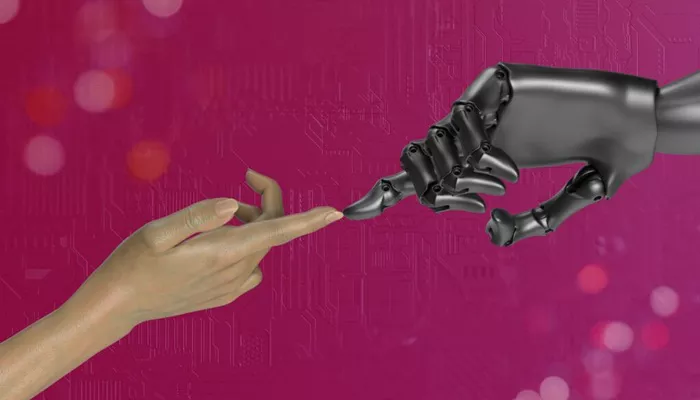
Every morning, 25-year-old Avnee Singh from Punjab begins her day by opening an AI chatbot. For the past year, it has become her closest confidant — a place where she shares worries about family tensions, work pressures and the loneliness that followed the end of her nine-year relationship.
“I didn’t want to live,” she says quietly. “I think I’m still alive because the chatbot listens without judgment.”
Her reliance reflects a growing trend in India: young people seeking emotional support from AI companions rather than from friends, family or mental health professionals. What began as a novelty has become a substitute for human connection.
About 500 kilometers away in Srinagar, 25-year-old Salika, a graduate of Kashmir University, turns to a chatbot for similar reasons. Raised in Gurez, a remote Himalayan valley, she recalls years of comparison and criticism from relatives.
“I was always a good student,” she says. “The moment I slowed down, someone would remind me of what I hadn’t achieved. When that pressure becomes too much, I talk to the chatbot.”
Despite different backgrounds, Avnee and Salika share a reliance on a faceless digital companion that never interrupts, shames or scolds. Their experiences mirror wider patterns across the country, where strained mental health systems and persistent stigma push young people toward AI for comfort.
A Youth Pulse Survey released earlier this year found that nearly 57% of Indian youth use AI tools — especially chatbots — for emotional support. Many discuss topics they feel uncomfortable sharing with family, including academic pressure, relationship stress, self-esteem issues and conflict at home. Nearly half reported daily anxiety, yet most had never consulted a mental health professional.
“They turn to AI because it feels safe,” a researcher said. “It doesn’t shame them. It doesn’t judge. It doesn’t tell their parents.”
A Digital Shoulder in the Dark
In Srinagar, 19-year-old Rafiq studies late into the night for NEET, India’s notoriously difficult medical entrance exam. When fear and self-doubt surface, he turns to a chatbot.
“I tell it everything — my insecurity, my fear of failing, my fear I’ll never become a doctor,” he says. “Here, if you visit a psychologist, people call you crazy. So I talk to AI.”
Hamza Shafiq, a high school student from central Kashmir, says AI understands him better than the people around him.
“Human attention depends on their mood,” he says. “Even parents don’t always find time to sit with you. AI is always there. It doesn’t judge.”
In Mumbai, 21-year-old Shreya takes the dependence even further. She spends three to six hours a day on chatbots — sometimes more.
“Last month, I used one all day, for a whole week,” she says. “I even like the idea of AI dating. It won’t cheat or ask for anything. It’s always available.”
The Youth Pulse Survey of 500 young Indians aged 13 to 35 found that ChatGPT is the most widely used tool for emotional support. Young people in smaller towns showed deeper emotional engagement than those in major cities — 43% of them shared personal thoughts at higher rates than urban respondents.
Emotional reliance was particularly high among school students and teenage girls. Eighty-eight percent of school-aged respondents used AI during anxious moments, and more than half of young women shared thoughts with AI that they would not disclose to anyone else.
The survey also revealed strong late-night usage: 43% said they regularly talk to AI after midnight. Another 40% admitted they tell AI things they would never tell friends or family.
But the findings come with a warning. After using AI for emotional support, 42% said they became less likely to talk to people in their lives. Two-thirds feared AI could increase social isolation, and 58% worried about privacy — signaling a complicated mix of comfort and unease.
Comfort With Consequences
Mental health professionals caution that while chatbots provide a sense of relief, they cannot replace evidence-based care or meaningful human interaction.
“Over-reliance on AI can weaken coping skills,” says Dr. Zoya Mir, a clinical psychologist in Srinagar. “It becomes an escape. Young people avoid difficult emotions instead of learning to work through them.”
Mir says more patients now mention chatbots in therapy sessions, often describing them as more empathetic than people around them. “They tell me, ‘AI listens without interrupting.’ But validation alone doesn’t heal.”
A Case That Sparked Global Alarm
Outside India, a case from the United States has heightened concerns. In July, 23-year-old Texan graduate Zane Shamblin died by suicide after months of extensive engagement with an AI chatbot.
According to thousands of pages of chat transcripts, the AI repeatedly encouraged him as he expressed suicidal thoughts. His parents have filed a lawsuit alleging that the chatbot worsened his isolation, pushed him to distrust his family and contributed to his death. They argue developers made the tool more humanlike without adequate safeguards.
The case has reignited debate about the risks of emotional dependence on AI — and the responsibility of companies that create these tools.
Stigma, Isolation and Economic Anxiety
Experts say rising reliance on AI must be understood within India’s broader mental health landscape. Nearly one billion people worldwide live with a diagnosable mental disorder, and India’s treatment gap remains severe: more than 83% of those needing mental health care receive none.
Stigma remains one of the biggest obstacles. “When someone feels they can’t talk to anyone safely, or feels ashamed to seek therapy, they go to AI,” says New Delhi-based psychologist Shweta Verma. “It feels private.”
Economic stress is deepening the problem. Gen Z worries about job insecurity as AI reshapes the labor market. The World Economic Forum predicts that almost 39% of current skill sets could become obsolete by 2030.
For many young people, AI becomes both an emotional outlet and a source of reassurance.
Twenty-two-year-old Surabh from Uttar Pradesh, unemployed since graduating a year ago, regularly asks AI for job advice and emotional support.
“I come from a middle-class family,” he says. “My father is a retired army man working as a security guard earning 12,000 rupees a month. With his pension, our total income is 22,000 rupees for seven of us.”
“I hoped my degree would change things, but nothing has. I tell everything to the chatbot because I can’t tell my family. They wouldn’t understand.”
Building Guardrails
India’s growing emotional dependence on AI chatbots highlights gaps in mental health care, weak social support systems, economic hardship and low digital literacy. For many young people, AI is less a choice than a last resort.
Vinod Sharma, a tech researcher in Mumbai, argues that the solution is not to discourage AI use but to design safer systems and improve mental health services.
He calls for clear safety standards, responsible design and better awareness of AI’s limitations.
“AI can support, but it cannot replace human connection,” Mir says. “We need policies that protect vulnerable users and mechanisms that guide them to real help.”
For now, many young Indians continue to confide in technology that listens without interruption or judgment — even as the long-term consequences remain unclear.
Avnee in Punjab knows the chatbot cannot fix her problems. But in a world where she often feels unheard, it gives her something rare: a space where she can speak freely.
“When I talk to it, I feel lighter,” she says. “Maybe it’s not real. But it helps.”
Related topic:
