
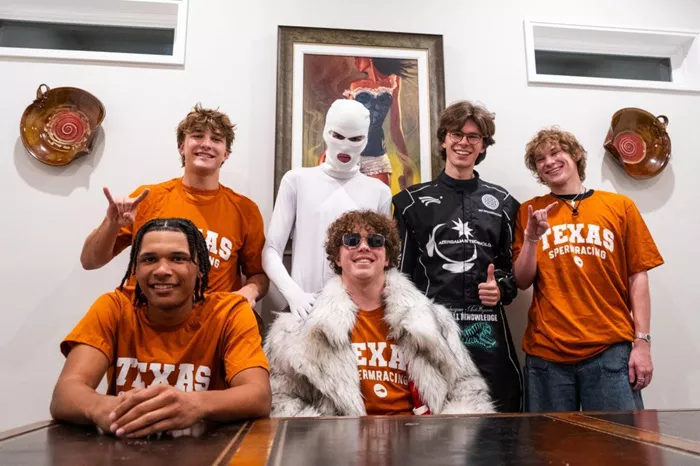
The University of Texas will host a sperm racing event on Jan. 30, pitting UT against Texas A&M in a competition designed to raise awareness about men’s fertility and reproductive health. The winner will receive a $10,000 cash prize.
Sperm racing, sometimes called “the world’s smallest sport,” tracks live sperm cells on a microscopic course using 3D camera technology. The events, which have garnered over one billion online impressions, are held on college campuses nationwide. Luke Hawash, also known as Dick Gay, is bringing the competition to Austin.
“The reason sperm racing exists is to address falling fertility rates and declining sperm health among Gen Z,” Hawash said. “Since the 1970s, sperm count, motility, and quality have been declining steadily.”
Hawash, recognizable in his white coat and black sunglasses, has gained millions of views online for his unconventional marketing, which often involves engaging strangers to participate. “You can tell people to eat healthy, but in today’s attention economy, that message doesn’t always stick,” he said. “Sperm racing meets people where they are.”
Participants provide sperm samples in private, which are then processed by biologists. The samples are placed into a microfluidic device—a small plastic and silicon track—where pumps, temperature, and pressure simulate a biological race to an egg.
“I realized the only thing I could excel at was my sperm, so I became a sperm racer,” said Asa Dowling, a UT mechanical engineering freshman. “When I saw the Instagram post, I knew it was my calling.”
Racers undergo extensive health testing, including blood, urine, and semen analysis, sponsored by diagnostics companies. Previous events, such as the USC vs. UCLA race, provided detailed reports on vitamin levels, sperm motility, and morphology.
“This sport is rooted in diagnostics, which is what makes it so exciting,” Hawash said.
Some participants, like UT business administration sophomore Lathan Coffee, see sperm racing as a way to reclaim their athletic identity and improve long-term health. “Healthy parents lead to healthy children,” Coffee said.
Sperm racing has also proven financially successful. Hawash said the USC vs. UCLA race raised more than $10 million, demonstrating growing interest in the sport.
By hosting events on college campuses, Hawash hopes to engage men at their most fertile age and encourage proactive family planning. “Targeting college students is a priority,” he said.
While the sport’s cheeky nature draws attention, Hawash emphasizes its educational mission. “Sperm racing isn’t just entertainment. It raises awareness about a real health crisis,” he said. “This is just the beginning, and we hope it becomes a lasting tradition in Texas sporting history.”
Related topic:
