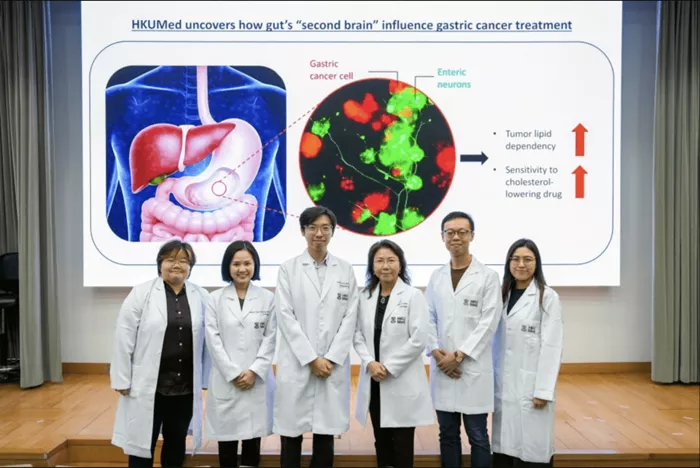
Stomach cancer is the sixth most common and deadly cancer in Hong Kong, with many patients diagnosed at an advanced stage, where the five-year survival rate remains low. Researchers at the University of Hong Kong’s Li Ka Shing Faculty of Medicine (HKUMed) have made a major breakthrough, uncovering how stomach cancer cells exploit the body’s “second brain”—the enteric nervous system—to fuel their growth.
The team successfully decoded the cancer cells’ metabolic mechanisms, revealing that enteric neurons act as a key “accomplice” in tumor development. Building on this discovery, the researchers developed a new therapy that can increase cancer cell-killing efficiency by more than sixfold. Their findings were published in the international journal Cell Stem Cell.
Blocking Cancer Cell “Energy” Cuts Tumor Growth
Previous research focused mainly on cancer cells themselves, but the tumor microenvironment also plays a critical role in disease progression. HKUMed’s study is the first to show that enteric neurons interact with stomach cancer cells, reshaping their metabolism and making them more dependent on lipids, including fatty acids and cholesterol, for growth.
Using gene-editing technology, the researchers screened roughly 20,000 genes and identified two key regulators of lipid metabolism:
ACACA – controls fatty acid synthesis
LSS – regulates cholesterol metabolism
These genes act as the cancer cells’ “energy factories.” In animal experiments, inhibitors targeting these factors reduced tumor growth by up to 65%.
Cholesterol Inhibitors Boost Anti-Cancer Effect
The team also developed a model to mimic the infiltration of stomach cancer tissue by enteric neurons. Results showed that combining neuron-targeted therapy with a cholesterol inhibitor increased cancer cell-killing efficiency by 6.3 times.
“Enteric neurons increase stomach cancer cells’ lipid demand, making them more vulnerable to cholesterol inhibitors,” said Professor Alfred Cheng Sing-Lung, Associate Professor at HKUMed’s School of Biomedical Sciences and lead author of the study. The discovery could help develop new drugs and improve predictions of patient responses, advancing precision medicine.
Potential Applications Beyond Stomach Cancer
Looking ahead, doctors may be able to use fatty acid metabolism markers in tumor tissue to identify patients most likely to benefit from lipid metabolism inhibitors, allowing for more personalized treatment plans.
The research team believes these findings could extend to other cancers with high neuron infiltration, including pancreatic and liver cancers. By expanding this approach, they aim to open new avenues for cancer therapy and drive innovative treatment breakthroughs.
Related topic:
- Automated Lung Organoids Offer New Platform For Cancer Test Research
- Government Rolls Out Automatic Healthcare Insurance Enrollment for Needy Citizens
- Scotland Launches App to Support Children with Type 1 Diabetes