
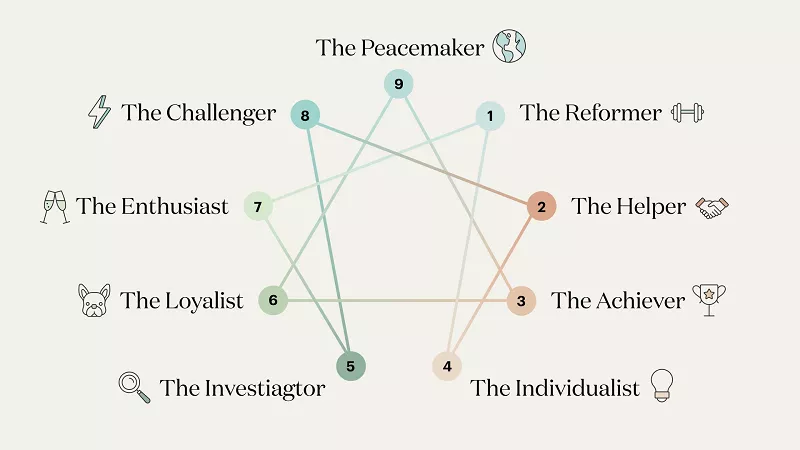
The Enneagram represents a personality typing system with roots in ancient spiritual traditions that has evolved into a modern psychological tool for understanding human behavior and motivation.
This system categorizes human personality into nine distinct types, each with characteristic motivations, fears, and behavioral patterns that influence how individuals perceive and interact with the world.
While its origins trace back to mystical traditions including Sufism and early Christian mysticism, contemporary applications focus on personal growth, interpersonal understanding, and psychological development rather than religious practice. The system’s enduring popularity stems from its nuanced approach to capturing human personality complexity through dynamic patterns rather than static categorizations.
Examining Historical Origins and Philosophical Foundations
The Enneagram’s earliest origins appear in Middle Eastern spiritual traditions, particularly within Sufism, which incorporated elements from Greek philosophy, early Christian mysticism, and Jewish Kabbalah. Twentieth-century figures including Armenian spiritual teacher George Gurdjieff introduced the system to Western audiences, emphasizing its psychological applications for self-awareness and personal transformation.
Chilean psychiatrist Oscar Ichazo further developed the system by correlating the nine personality types with specific psychological fixation patterns and defense mechanisms, creating a structured framework for understanding personality development.
His student Claudio Naranjo, a prominent psychiatrist, integrated Enneagram theory with modern psychology including psychoanalytic concepts and humanistic approaches, creating the foundation for contemporary therapeutic and organizational applications that focus on growth rather than pathology.
Understanding the Nine Core Personality Types and Characteristics
The system identifies nine distinct personality types that represent particular worldviews, coping strategies, and core motivations that drive behavior across different situations. Type One, the Reformer, strives for perfection and integrity with a focus on ethical behavior and self-improvement, while Type Two, the Helper, seeks love and validation through giving and meeting others’ needs.
Type Three, the Achiever, values success, recognition, and accomplishment, often adapting to expectations, whereas Type Four, the Individualist, pursues authenticity, meaning, and unique self-expression. Type Five, the Investigator, craves knowledge, understanding, and privacy to feel secure, while Type Six, the Loyalist, prioritizes security, preparedness, and reliable guidance systems.
Type Seven, the Enthusiast, seeks stimulation, variety, and avoidance of pain through optimistic planning, Type Eight, the Challenger, desires control, protection, and assertiveness in confronting challenges, and Type Nine, the Peacemaker, values harmony, comfort, and avoidance of conflict through accommodation and mediation.
Exploring Wing Theory and Personality Development Nuances
Each core type interacts with adjacent types on the Enneagram symbol, known as wings, creating unique personality variations that modify the primary type’s expression. For instance, a Type Three might demonstrate characteristics of either Type Two (3w2) showing more relational and helpful achievement styles or Type Four (3w4) exhibiting more individualistic and authentic expressions of success.
Wings contribute secondary traits that modify primary type characteristics, creating more individualized personality profiles that account for behavioral diversity within types. Understanding wing influences helps explain why individuals sharing the same core type may display significant behavioral differences in communication styles, emotional expression
and problem-solving approaches. This complexity allows for more personalized applications in therapeutic and organizational settings, acknowledging that personality expression exists on spectrums rather than in rigid categories.
Analyzing Modern Applications and Psychological Integration
Contemporary Enneagram applications span diverse fields including psychotherapy, business management, education, and personal development, focusing on practical benefits rather than mystical origins.
The Riso-Hudson Enneagram Type Indicator (RHETI) represents the most researched assessment tool, with demonstrated reliability in type categorization and growing research supporting its validity in predicting behavioral patterns. Organizational consultants utilize the system for team building, leadership development, and conflict resolution, while therapists employ it for relationship counseling, personal growth work, and understanding defense mechanisms.
Despite lacking full scientific validation compared to established psychological instruments, the system provides valuable frameworks for understanding behavioral patterns, interpersonal dynamics, and personal development paths that many find practically useful for self-awareness and relationship improvement.
Comparing the Enneagram with Other Personality Assessment Tools
The Enneagram differs significantly from instruments like the Myers-Briggs Type Indicator (MBTI) in its focus on core motivations, fears, and unconscious drivers rather than cognitive preferences and information-processing styles.
While MBTI categorizes how people process information and make decisions based on cognitive functions, the Enneagram explores why people behave as they do based on underlying emotional patterns, childhood adaptations, and survival strategies.
Both systems offer complementary insights for understanding personality, with the Enneagram providing particularly valuable perspectives on personal development paths, defensive pattern recognition, and emotional intelligence development.
The Big Five personality model offers scientifically validated trait measurements across five dimensions, whereas the Enneagram provides narrative frameworks for understanding personality organization, growth directions, and interpersonal dynamics that many find more accessible for personal application and therapeutic work.
Related topics
