
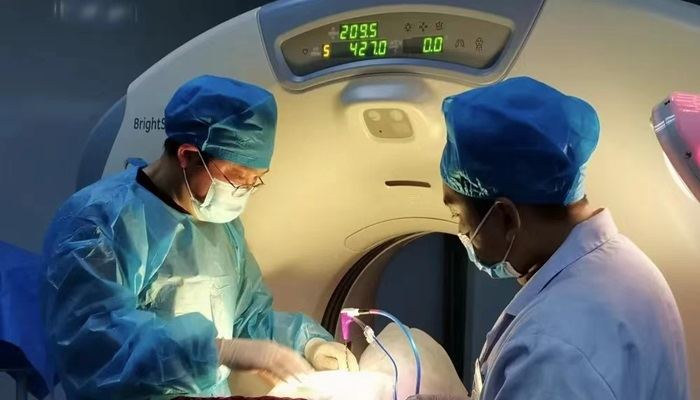
Nigeria has made history in the field of urology as Professor Kingsley Ekwueme, a consultant urologist, laparoscopic and robotic surgeon, successfully performed the first UroLift procedure in West Africa. The surgery was carried out at The Prostate Clinic (TPC) in Lagos and represents a major leap forward for men’s health care in Nigeria and the wider region.
Ekwueme, who also founded The Prostate Clinic, described the operation as a milestone in African medical history. “Today I performed the first UroLift procedure in West Africa, marking a historic step forward,” he said. He highlighted a key advantage: “The UroLift treats prostate enlargement while preserving both erection and ejaculation after surgery.”
What Is the UroLift Procedure?
The UroLift, technically known as the Prostatic Urethral Lift (PUL), is a minimally invasive option for treating benign prostatic hyperplasia (BPH), commonly referred to as prostate enlargement. Rather than cutting or removing prostate tissue, the procedure places small implants to lift and hold the enlarged prostate lobes away from the urethra. This relieves obstruction and improves urine flow while aiming to preserve sexual function.
Unlike traditional procedures, UroLift is often performed in a single day and can be done under local anesthesia. Because it avoids major tissue removal, it generally affords faster recovery and less risk of complications affecting erectile or ejaculatory function.
Clinical studies have demonstrated favorable outcomes. Over 145 peer-reviewed publications report sustained symptom improvements, enhanced urinary flow, and low retreatment rates over up to five years.
At 24 months of follow-up in one review, patients experienced improvements of about 36 % in IPSS score, 40 % in quality‐of‐life metrics, 54 % in BPH Impact Index, and 77 % in peak urinary flow rate (Qmax).
Compared to the gold standard surgical procedure, transurethral resection of the prostate (TURP), UroLift offers shorter recovery times and better preservation of sexual function, though it may deliver somewhat less symptom relief in severe cases.
In head-to-head trials, UroLift has shown low rates of retreatment (about 2–3 % per year, or ~13.6 % cumulatively over five years) and fewer instances of new-onset erectile or ejaculatory dysfunction.
Nonetheless, some reports note failure or recurrence rates ranging from 7 % to 22 % in certain centers, emphasizing the importance of patient selection and long-term data.
Patient Selection and Eligibility
Professor Ekwueme noted that UroLift is typically used in prostates up to approximately 80 mL in volume, though anatomical suitability must be confirmed via imaging and assessment. He stressed that every patient must undergo thorough evaluation, including cancer screening, to exclude malignancy and assess appropriateness for the implant procedure.
Because UroLift is less aggressive, it is especially appealing to younger men or those wishing to preserve fertility, erection, and ejaculation. It is not universally applicable; very large prostates, severe anatomical distortion, or extensive median lobes might preclude its use.
Significance for Nigeria and the Region
The local adoption of UroLift in Nigeria has the potential to reshape prostate care in West Africa. Professor Ekwueme emphasized the financial and emotional burden of medical tourism, estimating Nigeria loses nearly US $3 billion annually to overseas medical trips for advanced treatments. Having such advanced procedures available locally could reduce that outflow.
TPC (The Prostate Clinic) has already been a pioneer in robotic prostate surgery in Nigeria, Central, and West Africa. The inclusion of UroLift adds to its portfolio of state-of-the-art urological therapies. Ekwueme said: “We can now deliver world-class healthcare within our borders.”
This achievement positions Nigeria as a regional leader in prostate health care and may inspire further innovation and access across the African continent.
Risks, Limitations, and Conclusion
While UroLift is generally well tolerated and less invasive, side effects can include temporary hematuria, dysuria, urgency, pelvic pain, and urge incontinence. Rare but serious complications like bleeding or infection may require intervention.
Because long-term (>5 year) data are still limited, continued monitoring and follow-up research are essential.
In addition, comparative studies suggest that while UroLift performs well, symptom relief may not always match that of more aggressive surgical options, particularly for very severe BPH cases.
As experience accumulates in Nigeria and neighboring countries, outcomes data will help refine patient selection, optimize procedures, and offer guidance to urologists across Africa.
Related topics
