
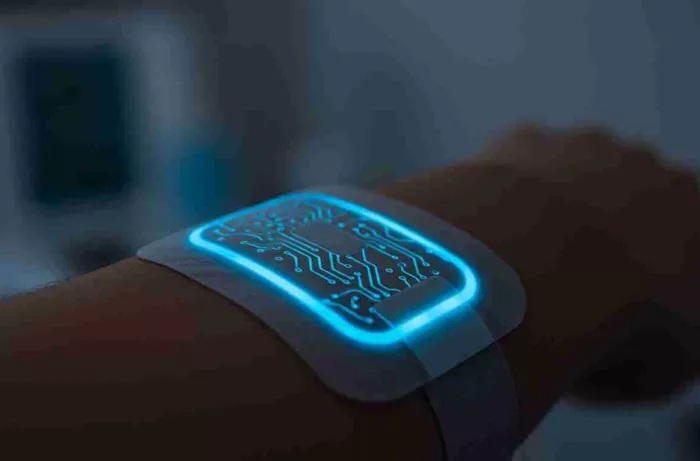
A new wearable sensor developed at the University of Southern California (USC) could transform how patients with bipolar disorder track their medication. Lithium, a common treatment for bipolar disorder, requires precise dosing that varies depending on body weight, diet, and other physiological factors.
Currently, lithium levels can only be measured through blood tests—procedures that are often time-consuming, inconvenient, and painful.
“Our goal was to create an easy-to-use sensor that bypasses the need for blood draws entirely,” said Yasser Khan, a professor in USC’s Ming Hsieh Department of Electrical and Computer Engineering and leader of the USC Khan Lab. Khan is also part of the USC Institute for Technology and Medical Systems (ITEMS), a collaborative initiative of the USC Viterbi School of Engineering and Keck School of Medicine.
In a study titled Wearable Organic-Electrochemical-Transistor-Based Lithium Sensor for Precision Mental Health, Khan’s team identified sweat as a non-invasive alternative to blood for measuring lithium levels in real time.
The device features a skin-safe, iontophoresis-based system that stimulates sweat production without physical exertion. Within minutes, data is collected and transmitted directly to a smartphone app, enabling patients to monitor their lithium levels from home.
The breakthrough is made possible by the use of organic electrochemical transistors (OECTs) specifically designed for lithium detection. These devices convert ionic signals in liquids into readable electronic data. Unlike conventional OECTs, the USC sensor uses a fully printed OECT with a novel material formulation optimized to detect lithium ions.
“We developed the entire lithium monitoring system—from the OECT-based sensor patch and on-demand sweat induction to the readout electronics and smartphone app—using a simple, scalable, and cost-effective fabrication process,” said Mohammad Shafiqul Islam, the study’s first author and a Ph.D. student in the Khan Lab. “Our goal was to make lithium tracking as easy and comfortable as checking a daily fitness tracker.”
This advancement marks the first fully printed OECT-based lithium sensor, paving the way for affordable, scalable production.
The device has already undergone pilot testing in collaboration with psychiatrist Adam Frank, MD, PhD, at the Keck School of Medicine. Sweat samples collected with the wearable accurately reflected lithium levels measured by traditional laboratory sensors. Patients reported relief at being able to monitor their medication without repeated hospital visits.
“The ability to non-invasively monitor lithium levels will improve care for patients taking lithium, who typically require regular blood draws,” said Frank. “Continuous monitoring will enhance safety by allowing dose adjustments that prevent side effects and reduce the risk of toxicity.”
Looking ahead, the USC team plans to integrate artificial intelligence into the wearable system to automatically optimize lithium dosing, aiming to maximize therapeutic benefits while minimizing side effects.
READ MORE
New Cumbria Hub Offers Same-Day Virtual Mental Health Care
Free Online therapy Anger Management Courses Offer Certificates
