
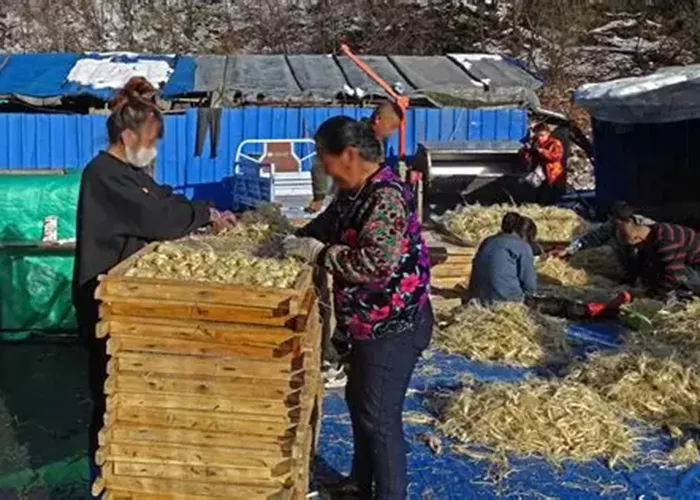
Nestled among mountains, Longshan County in Hunan Province has found a path to prosperity by cultivating Chinese herbal medicines like Phellodendron amurense and lilies. This not only restores the ecological environment but also boosts local incomes. With technological support, the herbal medicine industry chain continues to expand, becoming a “green bank” for enriching people and developing industries.
In the hinterland of the Wuling Mountains, mist shrouds the landscape. In Da’an Township of Longshan County, Xiangxi Tujia and Miao Autonomous Prefecture, greenery spreads over the hills, catching the eye.
Amidst the mountains, agricultural vehicles from over 300 herbal medicine planting cooperatives pass each other from time to time, leaving a faint medicinal fragrance. In the industrial park at the foot of the mountains, more than a dozen enterprises process Phellodendron amurense, lilies, honeysuckle and other herbs into over 60 products such as Chinese herbal pieces, health products and cosmetics, with an annual output value exceeding 1 billion yuan.
Once, this vast mountainous area in western Hunan, with more mountains and less land, made it hard for people to get rich. Now, the herbal medicine industry deep in the mountains has become a “green bank” for local people’s prosperity and industrial development.
“Magnolia forests on the top, Phellodendron patches on the middle, lilies fragrance at the foot”
What were the old days like?
Following the direction pointed by Ge Zhiwen, Party secretary of Dawang Village in Da’an Township, one can see that the land is uneven, and crops like corn grow in the crevices of stones.
“The village has over 10,000 mu of mountains, but only a little over 2,000 mu of arable land,” said Ge Zhiwen. In the past, people deforested and reclaimed mountains, trying to get food from the stone crevices. As a result, the ecological environment was damaged, and even desertification occurred.
Now, Zhong Changqi, a 55-year-old villager in Dawang Village, points to a lush forest and says that Phellodendron amurense grows here – under the green epidermis is the golden part used as medicine. A Phellodendron amurense as thick as a wrist can bring an income of 300 to 500 yuan.
“If planting corn is like villagers’ ‘current savings’, planting Phellodendron amurense is like a ‘fixed deposit’, depositing a good ecology into the ‘green bank’,” said Yang Tianyu, head of Da’an Township. In recent years, the village has relied on Phellodendron amurense for developing ecological industries, and controlling desertification also cannot do without it.
Around 2016, under the guidance of industrial policies and the demonstration drive of the village collective, Zhong Changqi planted 50 mu of Phellodendron amurense. Over the years, Zhong Changqi’s “passbook” has become thicker and thicker. “The thicker the tree grows, the more expensive it is!” said Zhong Changqi.
Dawang Village, which has benefited from the “green bank”, has returned farmland to forests in recent years, with Phellodendron amurense planting reaching 4,000 to 5,000 mu. Looking at Longshan County as a whole, 100,000 mu of wild herbal medicine and 200,000 mu of artificially planted herbal medicine bases present a scene of “magnolia forests on the top of the mountain, Phellodendron patches on the middle slope, and lilies fragrance at the foot of the mountain”.
“Let the land take a breath, relying on green technology”
Going down the winding mountain road, the wind is mixed with a hint of sweetness, and we arrive at the lily planting and processing base in Shipai Town, Longshan County.
“Longshan lily” is one of the “Xiang Jiuwei” – authentic medicinal materials in Hunan. The county’s lily planting area is stably maintained at 100,000 mu all year round, with an annual output of 100,000 tons.
Many years ago, Longshan County was already famous for lilies, but it also experienced a “crisis”.
“In the early years, for high yield, we used whatever fertilizer worked quickly,” said Zhang Guangdian, a large planter. “As a result, the land became stiff, the seedlings withered, the roots rotted, and the price of fresh lilies dropped to two or three yuan a jin. Who would dare to plant them?”
Based on the lily seed breeding base funded by the Ministry of Agriculture and Rural Affairs, Longshan County has cooperated with the Chinese Academy of Agricultural Sciences and Hunan Academy of Agricultural Sciences to prescribe remedies for lily “diseases”.
Selecting disease-resistant varieties cultivated by molecular breeding, rotating crops with gramineous plants, and increasing the application of organic fertilizers… Zhang Guangdian was one of the first practitioners of these ecological planting methods.
“Let the land take a breath, and it still depends on green technology,” said Zhang Guangdian. “The land has recovered, and the per mu yield has increased by 30%. In recent years, fresh Longshan lilies have been sold at no less than 20 yuan a jin, and dried slices are about 50 yuan a jin. The local medicinal materials have become a golden rice bowl.”
From “key technologies for deep processing of lilies” to “extraction of active ingredients from Phellodendron amurense”, Longshan County has carried out cooperation with more than 20 scientific research institutes in recent years. “At present, the county has built 3 expert workstations and 5 production, education and research demonstration bases, and science and technology contributes more than 50% to the output value of Chinese herbal medicines,” said Fu Feilong, a technical expert from the Bureau of Science, Technology and Industry Information of Longshan County.
Make the golden mountains and silver mountains more valuable, and let the people at home live a better life
The reporter followed a truck transporting Phellodendron amurense into Longshan Industrial Development Zone. In the park, modern dryers have replaced the past “sun drying and ground drying” methods. Sorting machines pick out uniform slices, and there are constant temperature warehouses and cold storage to ensure the safety of medicinal materials storage.
“The era of collecting medicinal materials with a sack and a scale, traveling over mountains and ridges, is gone,” said Deng Shaoguo, chairman of Hunan Henglong Chinese Medicinal Materials Co., Ltd., who has been engaged in the medicinal materials business since the early 1980s. He couldn’t help but sigh, “Development not only depends on expanding the scale, but also requires a sound interest linkage mechanism and comprehensive quality improvement of the industry.”
Now, the interest linkage mechanism between enterprises, cooperatives and farmers has become closer. In recent years, Longshan has built 3 towns with 10,000 mu of Chinese herbal medicine planting, 15 demonstration plots of 1,000 mu, 50 demonstration sites of 100 mu, and established more than 300 planting cooperatives.
Another enterprise, Hunan Shuangmu Pharmaceutical Co., Ltd., has sent batches of its technical personnel to Changsha, Hunan, Suzhou, Jiangsu and other places to learn in recent years.
“This is to lay the foundation for further deep processing,” said Zhou Xiaodan, the person in charge of the enterprise. In the past, the deep processing link was mainly completed by downstream manufacturers. “If these links can be placed locally in Longshan, the profit can be greatly increased.”
At present, the enterprise is preparing to build a new standardized processing plant to extend the industrial chain and enhance the value chain. Relevant departments are also implementing precise policies to protect the industrial ecology.
In recent years, Longshan County has formulated technical regulations for the production and processing of various authentic Chinese herbal medicines and built a whole industry chain standard system. At present, Longshan County has 10 high-tech enterprises engaged in Chinese herbal medicines, 7 provincial-level specialized, sophisticated, distinctive and novel small and medium-sized enterprises, and 6 provincial-level agricultural (forestry) industrialization leading enterprises.
“The Longshan County Party Committee and government have set up a work class for the Chinese herbal medicine industry chain, implementing precise policies in terms of strengthening the industry, building brands, and attaching importance to support, so as to make the golden mountains and silver mountains more valuable and let the people at home live a better life,” said Xiang Yiwen, secretary of the Party Working Committee of Longshan Industrial Development Zone.
Related topics:
Listeria Outbreak Plant Reopens, Raises Fresh Food Safety Concerns
Men’s Pelvic Health Awareness Grows with CC’s Physical Therapy
