
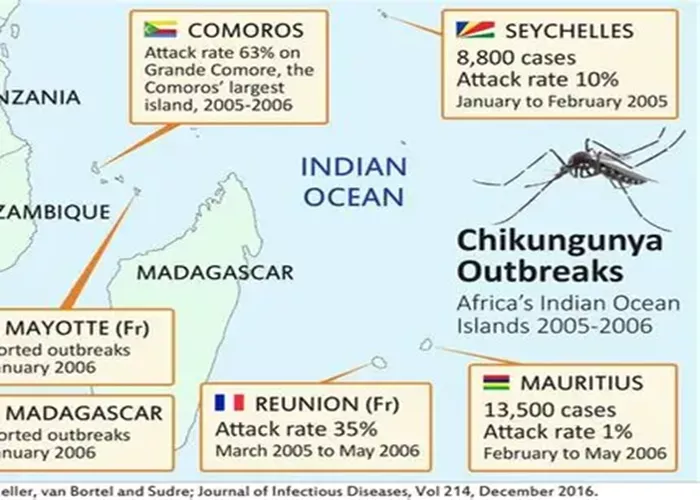
The World Health Organization (WHO) announced that a new round of chikungunya outbreak related to the Indian Ocean region has spread to Europe and other continents. The organization urgently called on countries to take immediate action to prevent a repeat of the global chikungunya virus epidemic that occurred 20 years ago.
The WHO stated that with the surge in imported chikungunya cases in Europe, local transmission has been reported in France. Since May 1st, approximately 800 imported cases have been reported in mainland France, and 12 local transmission cases have been confirmed in multiple regions of France.
French overseas departments have historically been severely affected by chikungunya. So, what experiences do the French public health authorities have in dealing with this disease? And why has the virus spread widely globally? The reporter from Science and Technology Daily interviewed Chen Xin, a researcher at the National Institute of Health and Law of Paris Cité University and a public – health expert at the French National Institute of Health and Medical Research, on these issues.
Europe No Stranger to Chikungunya
Chen Xin introduced that the southern region of France is one of the first areas in Europe to report local transmission of chikungunya. With numerous overseas departments and frequent personnel exchanges with French – speaking African countries, France has become a high – risk country for chikungunya in Europe. Imported cases in France used to occur concentratedly every 3 – 5 years, but with global warming and increased human mobility, the interval between chikungunya cases is shortening.
Historically, the most severe outbreak occurred in the French overseas department of Réunion from 2005 to 2006. More than one – third of the original island’s population was infected, with a total of over 266,000 cases and 250 deaths. The large – scale outbreak may have been caused by the lack of public – health prevention, disease – diagnosis and – treatment medical resources, as well as relatively backward public – awareness promotion of prevention and control.
After that, France stepped up the construction of the “National Mosquito – Borne Infectious Disease Surveillance System”, which was officially launched in 2010. In recent years, the system has been updated and released annually, tracking chikungunya while also paying attention to the spread of other mosquito – borne viruses such as dengue fever and Zika.
Establishing an Institutionalized Response and Prevention System
Chen Xin said that with many French overseas departments located in tropical regions, the risk of mosquito – borne infectious diseases is extremely high. Therefore, France has established a highly institutionalized, technological, and normalized response and prevention system, forming a set of mature prevention and control strategies at the national and community levels.
At the national level, the French National Health Agency, in conjunction with local public – health agencies and local health bureaus, dominates the operation of the “National Mosquito – Borne Infectious Disease Surveillance System”, which constitutes a complete monitoring and response chain through five links: capture, identification, detection, early warning, and response. Through the “EID – Med” program, France specifically monitors the distribution, quantity, and virus – carrying status of Aedes albopictus, providing real – time data support for decision – making departments. It also connects emergency departments, laboratories, and general – practitioner networks through an early – warning system. Once an abnormal trend in febrile diseases occurs, it can quickly respond, and in combination with climate monitoring and virus – risk assessment, initiate special deployments during extreme – temperature windows. In addition, France conducts a national summer infectious – disease prevention and control campaign, and every summer, it uniformly organizes prevention programs for dengue fever and chikungunya, jointly implemented by the Ministry of Health and regional health management.
At the community and medical – institution levels, France makes extensive use of a grass – roots sentinel system, that is, general practitioners and community pharmacies jointly form a high – density health – monitoring sentinel network to carry out. At the same time, it strengthens rapid hospital detection. For suspected cases, rapid screening is prioritized, and gene – amplification laboratory detection is accelerated for confirmation to ensure timely diagnosis.
France also forms an emergency – response enhancement mechanism through associated data collection. Once the monitoring and assessment determine that the risk reaches level three (national – level epidemic response), it can quickly launch high – density regional interventions, including the release of mosquito – killing agents, environmental – medical treatment, the arrangement of patient – diagnosis and – treatment channels and triage tents, and the coordination of implementation at all levels according to official prevention and control guidelines. At the same time, it strengthens the protection of key groups, focuses on monitoring high – risk groups such as the elderly, children, pregnant women, and those with chronic diseases. Hospitals optimize the medical – treatment process and triage mechanism, especially strengthening the control of nosocomial infections.
This comprehensive prevention and control mechanism, characterized by national overall planning, regional linkage, community – grid, and hospital – system coordination, provides a mature model for the response to mosquito – borne diseases.
Climate Change Facilitates Global Spread
Chen Xin said that according to recent research by the European Public Health Agency, with the global temperature rise and changes in humidity and precipitation patterns, the suitability of mosquito vectors (especially Aedes albopictus) to the European climate is constantly increasing, leading to the spread of tropical mosquitoes to more northerly and higher – altitude areas and extending their activity season, resulting in the northward shift of the risk of related virus transmission.
According to the relevant model of the Pasteur Institute, the inland areas of France currently have the climatic conditions for chikungunya virus transmission. Historically, the confirmed chikungunya cases in France mainly originated from external imports. In recent years, with climate change, the number of locally – transmitted cases infected by mosquito vectors has increased significantly.
In June this year, multiple regions in France, including the northeast, reported local transmission cases for the first time, with the time being significantly advanced, indicating that the virus transmission window has expanded.
At the European policy level, in the face of the expansion of the mosquito – vector living environment brought about by climate change, it is necessary to establish a comprehensive early – warning system of “climate – suitability model northward – spread prediction”, otherwise it will be difficult to deal with the rapid changes such as the extension of the transmission window. The French government has required continuous improvement of cross – departmental response capabilities in recent years. Dealing with the chikungunya epidemic requires the comprehensive linkage of meteorological, public – health, environmental, and tourism – management departments.
Regarding the spread of the chikungunya virus in China, Chen Xin said that according to French experience, the R0 of chikungunya is between 1.5 and 2.0. If prevention and control are not in place, there may be a risk of expansion. However, the virus itself does not have the conditions for widespread diffusion and does not spread from person to person. Therefore, individuals do not need to worry too much. He suggested that China strengthen quarantine efforts for inbound luggage and personnel from low – latitude epidemic – source countries; carry out continuous mosquito – control activities in relevant provinces and cities, clear container water, and carry out environmental – medical treatment in special areas; and also follow the example of France to establish a sentinel – monitoring system, build a “high – temperature + mosquito – vector” early – warning system, and timely release authoritative prevention and control guidelines.
Related topics:
Experts Warn Against Excessive Sweating Amid Summer Sauna Craze
IVF Breakthrough: 8 ‘Three-Parent Babies’ Born Mitochondria Disease-Free
Korea’s Personality Test Obsession: A Mirror to Inner Struggles
