
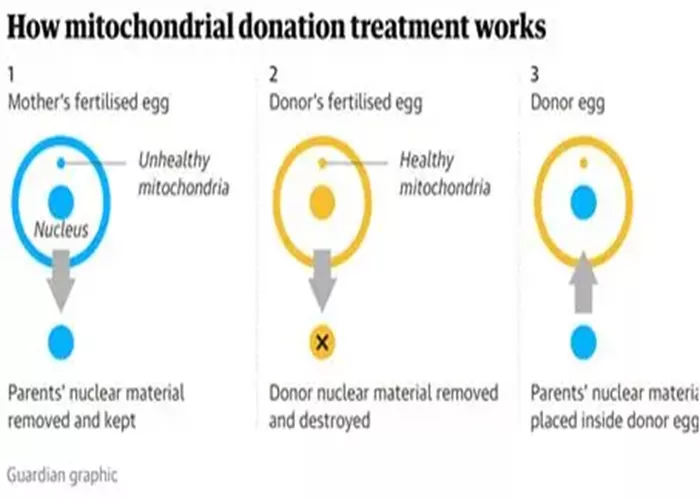
A research team led by Newcastle University in the UK has announced that a pioneering in vitro fertilization (IVF) technique called pronuclear transfer, designed to prevent the inheritance of mitochondrial DNA diseases, has successfully helped eight babies be born healthy. The infants—four boys and four girls, including a set of identical twins—were born to seven women carrying high-risk mitochondrial DNA mutations, yet none show signs of mitochondrial diseases.
The technique works by transferring the nuclear DNA from the mother’s fertilized egg into a healthy donor’s egg that has had its nucleus removed, thereby avoiding passing on pathogenic mutations in the mother’s mitochondrial DNA to the next generation. The resulting embryo carries nuclear DNA from both parents and mitochondrial DNA from the donor, earning them the nickname “three-parent babies.”
Since its inception, the technology has attracted global attention and is currently only approved in the UK and Australia, according to public reports.
Two new papers published in The New England Journal of Medicine detail the reproductive and clinical outcomes of pronuclear transfer treatments conducted to date. All babies were healthy at birth, with the mother’s pathogenic mitochondrial DNA mutations either undetectable or at extremely low levels—well below the threshold for causing disease.
Long-Term Follow-Up Remains Critical Despite Success
Mitochondrial diseases, caused by genetic mutations in mitochondria, can lead to muscle weakness, epilepsy, developmental delays, organ failure, and even death. While conventional IVF screening can identify most mutations, uncertainties often remain, prompting the development of “three-parent baby” technologies.
The team reported that 22 attempts resulted in eight births, with one mother still pregnant. Close monitoring during pregnancy and post-birth follow-ups showed six of the seven women had smooth pregnancies; one experienced a rare complication—hyperlipidemia—which was controlled with a low-fat diet.
Among the eight babies, five showed no detectable pathogenic mitochondrial DNA mutations in blood and urine cells. The remaining three had mutation levels of 5%-9%, 12%-13%, and 16%-20% respectively—far below the 80% threshold for clinical symptoms. In 18-month follow-ups, mutation levels in the first two children dropped to undetectable levels.
Though three infants initially had health issues—transient startles, hyperlipidemia, and arrhythmias—the team deemed these unrelated to mitochondrial mutations, as all resolved with treatment. They emphasized the need for continued follow-ups, particularly developmental assessments for children under five, to ensure long-term safety.
Ethical Controversies and Ongoing Safety Debates
Despite its success, the technology remains mired in ethical disputes. Critics worry that embryo gene modification could have unknown effects on future generations, with errors potentially introducing harmful mutations into the human gene pool. They also fear it may open the door to “designer babies” through genetic manipulation.
“This is biologically and culturally dangerous as it marks the beginning of biological engineering, which may eventually extend beyond disease prevention to customizing babies through genetic manipulation,” said Stuart Newman, professor of cell biology and anatomy at New York Medical College.
The United States prohibits such heritable genetic modification technologies, with annual congressional appropriations bills restricting related clinical research.
Dr. Zev Williams of Columbia University noted U.S. regulators restrict technologies causing heritable embryonic changes, adding, “Whether this will change remains uncertain, depending on evolving scientific, ethical, and policy discussions.”
Scientists stress the technology’s safety. Robin Lovell-Badge, a stem cell and developmental genetics expert at London’s Francis Crick Institute, noted one infant with slightly higher abnormal mitochondrial levels—still far below disease thresholds—requires ongoing monitoring during development.
Addressing ethical concerns, Lovell-Badge argued the donor’s DNA contribution is “negligible,” far less than in bone marrow transplants, and that children born through the technique would not inherit any traits from the mitochondrial donor.
Dr. Andy Greenfield, a reproductive health expert at the University of Oxford, hailed the work as “a victory for scientific innovation,” offering the only hope for women for whom other methods like early embryo screening fail.
Lead author Professor Mary Herbert of Newcastle University stated, “These findings give us reason for optimism, but deeper understanding of the technology’s limitations is crucial to improving outcomes.”
UK regulators have approved 35 patients for the technique, with each case requiring individual approval.
Balancing Risks and Benefits to Dispel Genetic Disease Clouds
For families affected by mitochondrial diseases, the technology offers unprecedented hope. One mother who gave birth to a healthy baby through the technique said, “As parents, our only wish was to give our child a healthy start in life. Science gave us that chance.”
Another mother added, “We have a healthy baby—the mitochondrial transfer worked, lifting the cloud of fear that once hung over us.”
Liz Curtis, whose daughter Lily died from a mitochondrial disease in 2006, founded the Lily Foundation to support research including Newcastle’s work. Recalling the despair when Lily was diagnosed—with doctors unable to explain her condition or prognosis—she emphasized the technology’s significance: “It lights a candle for people who saw no hope.”
Dr. Williams summarized that the research could help more couples conceive safely, and with scientific progress and policy debates, “three-parent baby” technology may open new paths in global mitochondrial disease prevention.
Undoubtedly, this technology pushes ethical and medical boundaries, carrying hope in the fight against rare genetic diseases while requiring ongoing monitoring and global collaboration to balance risks and benefits.
Related topics:
Toddler Virilised by Father’s Testosterone Gel: Safety Warnings Issued
Gen Z Men Drive Trillion-Dollar Shift in Male Health Industry
Living With Low Testosterone? Weight Loss Drugs Offer New Hope
