
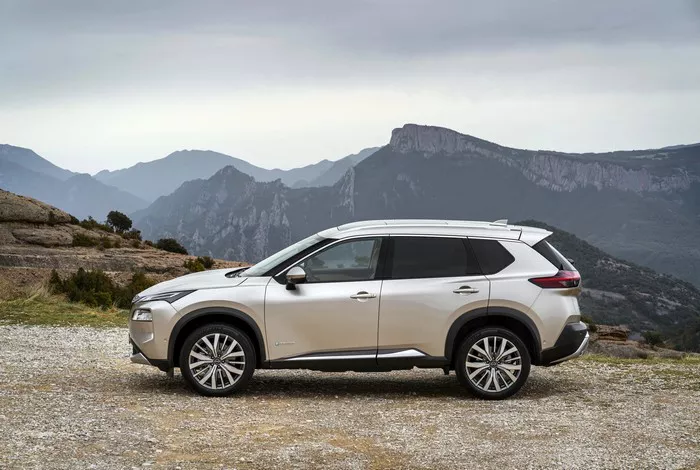
Nissan Motor is introducing a novel hybrid system to the U.S. market later this year, designed to provide the driving experience of an electric vehicle while relying on a traditional gasoline engine. Called “e-Power,” this series hybrid uses its gas engine solely as a generator to power electric motors that drive the wheels, distinguishing it from conventional hybrids like the Toyota Prius, where the engine directly contributes to propulsion. Unlike plug-in electric vehicles or extended-range EVs, the e-Power system requires no external charging, operating instead like a self-contained electric drivetrain fueled by gasoline.
The e-Power system is set to debut domestically in a new iteration of Nissan’s popular Rogue compact SUV. Nissan’s engineers say the timing is ideal, given rising fuel costs, slower-than-expected adoption of full battery electric vehicles, and a projected increase in hybrid sales. According to S&P Global Mobility, hybrid vehicles are expected to account for 18.4% of new U.S. vehicle sales this year, up from 12.6% in 2025, while pure EVs are projected to decline slightly to 7.1% of new sales.
“This is a unique powertrain for the U.S.,” said Kurt Rosolowsky, Nissan North America vehicle evaluation and test engineer. “It’s an electrically driven vehicle in terms of what powers the wheels, but it doesn’t require a plug, and you fill it with gasoline like a conventional car.”
Series hybrids are not new for Nissan or other automakers, particularly in Asia, but adoption in the U.S. has lagged due to consumer expectations around driving performance and dynamics. To address these concerns, Nissan has developed a more powerful 1.5-liter three-cylinder turbocharged engine specifically for the U.S. e-Power system, complemented by updated packaging and engineering refinements. The turbocharged engine functions primarily to maintain efficiency at higher speeds by generating energy for the electric motors rather than directly driving the wheels.
The e-Power system represents Nissan’s third-generation series hybrid since its 2016 debut in Japan, where the company has sold more than 1.6 million vehicles across nearly 70 countries. Market analysts expect the technology to appeal to U.S. buyers, particularly with the upcoming Rogue, though the system is less efficient at sustained high speeds—an issue Nissan is addressing with engine and battery improvements.
Test drives of the European Rogue Sport equipped with e-Power have highlighted its quick acceleration and strong regenerative braking. Drivers experience the familiar sound of an engine without the shifting or vibration typically associated with a traditional transmission, delivering a quieter, smoother ride. The system eliminates the need for a conventional transmission and driveshaft, simplifying the drivetrain while retaining the performance feel of an EV.
While the current U.S. specifications for the e-Power Rogue, including pricing and fuel economy, have not been released, the European Rogue Sport version reportedly achieves over 40 miles per gallon in heavy city traffic. This is a notable improvement over the standard U.S. Rogue, which averages more than 30 MPG depending on the model.
Nissan has not confirmed whether e-Power will be expanded to other U.S. vehicles but emphasized that the system is modular and could be adapted to different gasoline engines. “You can theoretically bolt this onto another gasoline engine of a different size and have more options for an e-Power system,” Rosolowsky noted, leaving the door open for broader deployment in the future.
