
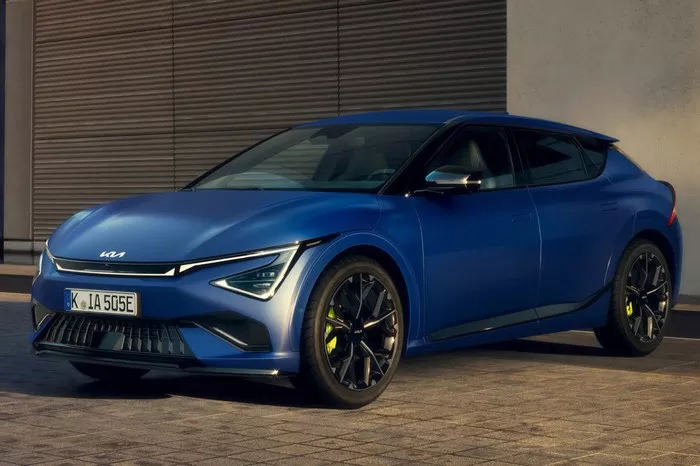
Tariffs continue to exert a powerful influence on the automotive industry, and recent developments underscore their far-reaching impact. Rising production and import costs have forced automakers and suppliers to restructure global supply chains, a burden that inevitably trickles down to consumers through higher vehicle prices. In some cases, tariffs even make certain models financially unviable in the U.S. market, prompting manufacturers to remove them from sale entirely.
The latest example comes from South Korea, where the refreshed Hyundai Ioniq 6 for the 2026 model year will no longer be sold in the United States. The only exception is the high-performance Ioniq 6 N, which remains slated for release. Shortly afterward, Kia announced an indefinite delay of the 2026 EV6 GT, the top-tier electric version of its EV6 crossover.
High-Performance EVs Hit by Import Tariffs
Most Kia EV6 models are produced at the company’s West Point, Georgia factory, which allows them to avoid tariffs. The EV6 GT, however, is assembled in South Korea. When a 25% import tariff on foreign-built vehicles took effect, it became economically challenging to sell the GT in the U.S.
The EV6 GT is far from a standard electric crossover. Its dual-motor all-wheel-drive system delivers 641 horsepower in launch control mode, placing it among the fastest EVs in its class. Yet the combination of overseas production and the new tariff has forced Kia to pause the U.S. launch of the model.
“Delivering strong performance and solid value remains a priority,” Kia said in an official statement, “but changing market conditions have necessitated an indefinite delay of the 2026 EV6 GT.”
Other EV6 Models Remain Available
Kia emphasized that U.S.-built EV6 models are unaffected and will continue to be sold normally. Prior to its removal, the 2025 EV6 GT started at $65,295. A 25% import tariff would have significantly increased the price, potentially making it uncompetitive in the U.S. market.
Dealership inventories reflect the change: the 2025 EV6 GT is no longer listed on Kia’s U.S. online configurator, and no new units appear to be available nationwide. Other EV6 trims, however, remain available for order.
Sales Decline Adds Pressure
Tariffs alone do not explain the model’s delay. Overall EV6 sales in the U.S. fell sharply this year, dropping about 60% in the first two months to just 1,140 units. The GT, being the most expensive trim, likely accounted for only a small portion of those sales.
Kia is also delaying the U.S. launch of two additional South Korean-built EVs, the compact EV4 sedan and the EV3 hatchback, which face the same tariff-related obstacles.
An Uncertain Path Forward
For now, the future of the EV6 GT in the U.S. remains uncertain. One potential solution would be relocating production to the United States to bypass import duties. Until then, consumers seeking high-performance EVs may have to look elsewhere.
The EV6 GT situation highlights how political decisions, such as tariffs, can reshape the automotive market just as dramatically as technology, consumer demand, or manufacturing innovations.
