
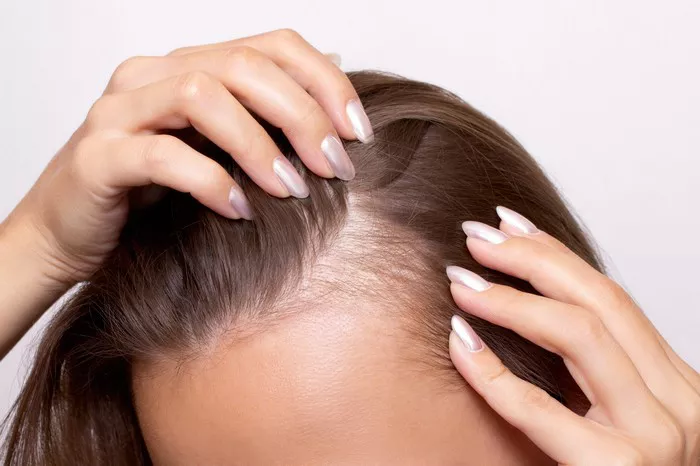
Many women are surprised when they begin to notice extra strands of hair collecting on the bathroom floor or a widening part in the mirror. While hair loss is often associated with men, medical experts say women—especially those entering perimenopause—are also commonly affected, and the condition can be both distressing and confusing.
Doctors refer to the most common form of hair thinning in women as female-pattern hair loss, or androgenic alopecia. It is the same underlying condition that affects many men, but it presents differently. Instead of a receding hairline or bald patches, women usually experience a gradual thinning across the top of the scalp, giving hair a less dense appearance rather than causing complete baldness.
“Women with very severe or sudden hair loss should always see a dermatologist,” said Dr. Song Park, a dermatologist and hair disease specialist at UW Medicine’s Eastside Specialty Center. “About one in 10 women I see for hair loss actually has a different condition, not androgenic alopecia.”
Those rarer forms include frontal fibrosing alopecia, which can also affect the eyebrows and eyelashes, and central cicatricial centrifugal alopecia, a permanent and sometimes painful form of hair loss that occurs more frequently in Black women. Early diagnosis is critical in these cases to prevent irreversible damage.
For most women in midlife, however, hormonal shifts play a major role. As estrogen levels drop during perimenopause, the relative influence of androgens increases, making certain areas of the scalp more sensitive. Genetics, reduced blood flow around hair follicles, and slower stem-cell regeneration in the scalp also contribute to thinning hair.
Despite a crowded market of shampoos, serums, and supplements promising thicker hair, dermatologists say there is only one treatment that has been consistently proven and approved by the U.S. Food and Drug Administration: minoxidil. Available over the counter as a topical foam or solution, minoxidil is applied directly to the scalp and works by stimulating hair follicles to enter a healthier growth cycle. Foam versions are often preferred because they are easier to use and less irritating.
Minoxidil is also available by prescription in pill form for women who prefer not to apply it daily. Most users begin to see results within a few months. While stopping the treatment can allow hair to thin again, experts stress that it does not cause sudden or catastrophic hair loss, another common myth surrounding the drug.
Some women turn to natural alternatives, such as rosemary oil, which has shown limited promise in small studies on men. However, experts say there is not enough evidence to support most herbal or supplement-based treatments, including popular options like biotin, which can even interfere with lab test results.
The medical consensus is clear: while hair loss cannot be fully reversed without procedures such as transplants, it can be effectively managed. Women who notice thinning during perimenopause are encouraged to consult a dermatologist, avoid unproven products, and rely on treatments backed by solid clinical research.
