
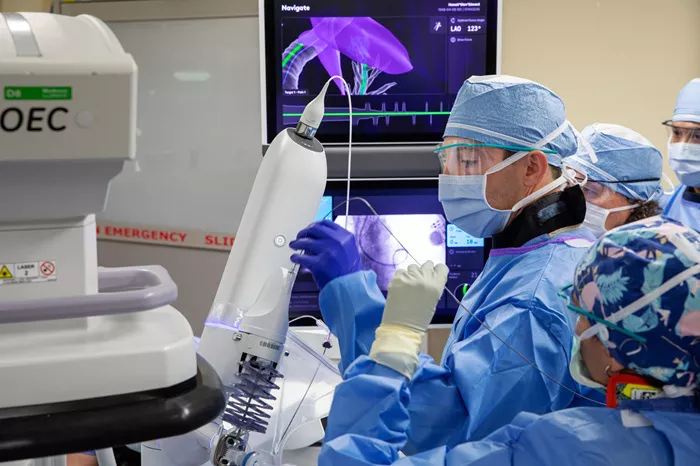
An advanced robotic bronchoscopy system designed to improve early lung cancer detection is now being used at Robert Wood Johnson University Hospital (RWJ) and Rutgers Cancer Institute in New Brunswick.
The Ion robotic bronchoscopy platform enables interventional pulmonologists and thoracic surgeons to access small lung nodules that are often unreachable with conventional bronchoscopic tools. These nodules frequently represent early-stage disease, when treatment outcomes are more favorable.
The technology arrives as lung cancer remains the deadliest cancer in the United States, accounting for roughly one in five cancer deaths, according to the American Cancer Society (ACS). The organization estimates approximately 226,650 new lung cancer cases and 124,730 deaths nationwide in 2025.
Lung cancer causes more deaths than colon, breast, and prostate cancers combined. In New Jersey alone, about 5,800 residents are diagnosed each year. Nationwide, only about 25 percent of patients are diagnosed at an early stage, when survival rates are significantly higher.
At RWJ, clinicians are using robotic-assisted bronchoscopy to perform precise biopsies in the peripheral regions of the lung, where more than 70 percent of cancerous nodules develop. These areas are particularly difficult to reach using standard bronchoscopes.
The Ion system combines robotic navigation with shape-sensing technology, allowing physicians to maneuver through all 18 lung segments with enhanced stability and precision. Tissue samples are collected through a minimally invasive approach, reducing procedural risk for patients.
Physicians at RWJ say the platform improves their ability to biopsy small or complex nodules that previously could not be accessed. Early diagnosis, they note, often depends on reaching these hard-to-navigate regions.
The system is especially valuable for high-risk patients, including long-term smokers, individuals with a history of cancer, and patients whose nodules are located in anatomically challenging areas.
RWJBarnabas Health has introduced the Ion system at multiple hospitals across its network. The health system also emphasizes early detection through its Lung Cancer Screening Program, which offers low-dose CT scans, centralized scheduling, insurance assistance, smoking cessation support, specialist coordination, interpretation services, and transportation assistance.
The screening program follows national guidelines, targeting individuals aged 50 to 80 (or up to 77 for Medicare beneficiaries) who currently smoke or quit within the past 15 years, have no lung cancer symptoms, and have a smoking history of at least 20 pack-years. Eligible patients must not have had a chest CT scan within the previous year.
Patients diagnosed at RWJ are referred to thoracic and surgical oncologists at the Jack & Sheryl Morris Cancer Center. The recently opened facility includes infusion suites, imaging services, operating rooms, private inpatient rooms, and advanced radiation technologies such as MR-LINAC systems. It also supports clinical trials, cellular therapies, and specialized surgical care.
As robotic procedures expand in hospital settings, researchers and companies are also pursuing less invasive approaches to detect cancer earlier than traditional imaging and biopsy methods allow.
Louisville-based Breath Diagnostics is developing a non-invasive breath test that analyzes volatile organic compounds associated with cancer metabolism. The technology captures breath samples and examines chemical signatures believed to reflect metabolic changes in cancer cells. The company says the test could be completed in minutes and may allow more frequent screening of high-risk populations without radiation exposure.
Grail Inc. has developed the Galleri blood test, which aims to detect more than 50 types of cancer from a single blood draw. The test analyzes tumor-derived DNA fragments in the bloodstream, searching for abnormal chemical markers that signal the presence of cancer and suggest its tissue of origin. The approach targets cancers that currently lack routine screening tools and are often diagnosed at advanced stages.
While both technologies remain under evaluation, researchers view them as part of a broader effort to create scalable early-detection tools. Many clinicians expect these methods to complement, rather than replace, imaging and biopsy procedures.
The oncology field is also investing heavily in radiomics and artificial intelligence, which analyze medical images to identify subtle patterns that may escape human review. These tools can assess changes in nodule shape, density, or texture, potentially flagging areas of concern earlier and guiding follow-up testing.
Meanwhile, pharmaceutical and biotechnology companies continue to develop targeted therapies and immunotherapies tailored to specific genetic mutations and tumor biology. Experts say these treatments are most effective when cancer is identified early, increasing the urgency for improved detection technologies.
RWJ officials say robotic-assisted bronchoscopy aligns with this broader push toward earlier intervention. The technology offers a minimally invasive option that reduces risk, improves diagnostic accuracy, and may decrease the number of inconclusive biopsies that require repeat procedures.
As research and innovation accelerate, hospitals, diagnostic developers, and biotech firms continue to focus on shifting more patients into early-stage diagnosis, where treatment options are broader and outcomes are generally better.
Related topic:
