
Two lawmakers from opposite political parties are once again joining forces to remove the financial barriers that prevent many women from receiving essential breast cancer screenings.
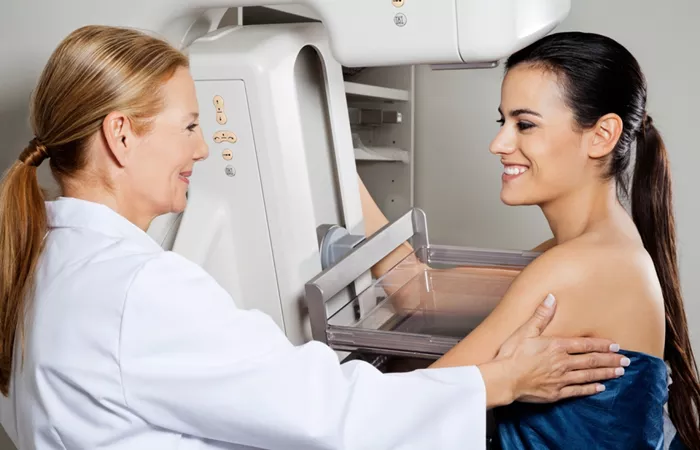
On Thursday, Rep. Rosa DeLauro, a Democrat from Connecticut, and Rep. Brian Fitzpatrick, a Republican from Pennsylvania, reintroduced the Find It Early Act. The bill is supported by journalist and advocate Katie Couric. It would require all health insurance plans to fully cover both screening and diagnostic breast imaging with no out-of-pocket costs. This includes mammograms, ultrasounds, MRIs, and any follow-up tests that doctors recommend when results are unclear or potentially concerning.
The proposal would significantly benefit women with dense breast tissue, a group that includes nearly half of women over age 40, according to the Centers for Disease Control and Prevention. Dense tissue increases breast cancer risk and makes tumors harder to detect on a standard mammogram. As a result, many women need additional imaging, such as ultrasounds or MRIs. These tests can be costly, and insurers often deny coverage. The Find It Early Act aims to remove these financial obstacles so cancers can be detected earlier, when treatment is most effective.
Katie Couric has supported this initiative since its earliest days. She stood with the lawmakers when the effort was first announced in 2022 and again when it was introduced in Congress in 2023.
“The Find It Early Act is a critical step toward improving access to lifesaving screenings,” Couric said. “I am incredibly thankful to Congresswoman DeLauro and Congressman Fitzpatrick for joining with me in this effort to save millions of lives.”
For Couric, this issue is personal. She was diagnosed with breast cancer in June 2022, despite having no family history. Because she has dense breasts, she has long needed supplemental ultrasounds along with her mammograms. She has become a strong advocate for ensuring that all women—not only those who can afford extra imaging—can access the tests that their doctors recommend.
“I feel incredibly fortunate that I was diagnosed early, but so many women find out too late,” said Couric, who is also a co-founder of Stand Up To Cancer. “Improving access and coverage for additional testing, especially for women with dense breasts, will save lives.”
DeLauro emphasized that early detection remains the most powerful tool for improving survival. “If we find it early, we save lives,” she said. Research supports her statement: When breast cancer is found at the localized stage, the five-year relative survival rate exceeds 99 percent, according to the American Cancer Society.
Fitzpatrick, whose mother and sister are both breast cancer survivors, called the bill “a bipartisan effort to eliminate barriers that never should have existed in the first place.”
The legislation would create national standards for breast imaging coverage, replacing today’s inconsistent state-level rules.
“Every day, women across this country skip or delay critical imaging because of cost,” Fitzpatrick said. “The Find It Early Act ensures every woman, regardless of risk or income, can access comprehensive breast screening with no cost-sharing.”
If passed, the bill could help more women receive timely scans and catch cancers earlier, when treatment outcomes are far better. The measure must still move through committee review and gain additional co-sponsors before it can advance to a floor vote. Its future is uncertain, but for millions of women, its impact could be profound.
Related topics
