

A new report from the Milken Institute highlights significant geographic disparities in access to breast cancer screening across the United States. The analysis estimates that approximately 9,600 additional breast cancer cases could be detected earlier if counties with low mammography capacity achieved detection rates comparable to high-capacity areas.
Mapping Mammography Capacity Across the U.S.
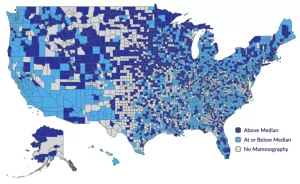
The report, Opportunities for Local Mammography Deployment, examined the location of every FDA-certified mammography machine in the country using data from the FDA’s Mammography Program Reporting and Information System. Researchers identified 890 counties with no mammography machines and noted substantial gaps in capacity across the Southwest and Great Plains regions.
Counties with fewer mammography resources tended to have smaller populations, higher proportions of racial and ethnic minorities, higher poverty rates, lower rates of health insurance coverage, and larger percentages of households with limited English proficiency. Among female Medicare enrollees in these low-capacity counties, only 38% had received a mammogram in the past year, compared with 48% in high-capacity counties.
Potential Impact on Early Detection
The report estimates that if low-capacity and no-capacity counties could achieve detection rates similar to high-capacity areas, about 4,200 cases of ductal carcinoma in situ (DCIS) could be detected before progressing to later stages. Early detection of DCIS is particularly important because it can prevent invasive breast cancer and improve long-term survival.
The analysis also identified 74 counties where adding mammography machines could offer a high return on investment for both overall breast cancer detection and early-stage DCIS detection. Notable examples include Broward County, Florida, and Adams County, Colorado.
Beyond Equipment: Barriers to Screening
While increasing the number of mammography machines is a critical step, the report emphasizes that equipment alone is not enough to close the detection gap. Other factors—including cost, language barriers, lack of paid leave, and low engagement with the healthcare system—also affect screening rates.
The study found that even in counties with high mammography capacity, low detection rates persist when women face financial or logistical barriers. Small copayments and absence of a regular healthcare provider were associated with lower adherence to screening recommendations, indicating that access challenges extend beyond machine availability.
Regional Disparities and National Context
The Southwest emerged as a particular area of concern, with multiple counties showing both low capacity and low detection rates. In California, despite a high total number of mammography machines, per-capita capacity is relatively low due to the state’s large population.
The report analyzed county-level breast cancer data from 2017–2021 and population data for women aged 40 and older, the age group most commonly recommended for mammography screening. Breast cancer remains a significant public health concern, causing more than 42,000 deaths annually in the U.S. Although mortality rates have fallen by 44% between 1989 and 2022, increased screening contributed to roughly 25% of that reduction.
Conclusion
The Milken Institute report, authored by Andrew Friedson, Abigail Humphreys, Bumyang Kim, and Katherine Sacks, underscores the persistent geographic and socioeconomic disparities in breast cancer screening. Addressing these gaps will require not only improved mammography capacity but also targeted strategies to overcome financial, logistical, and systemic barriers to care.
Related topics
