
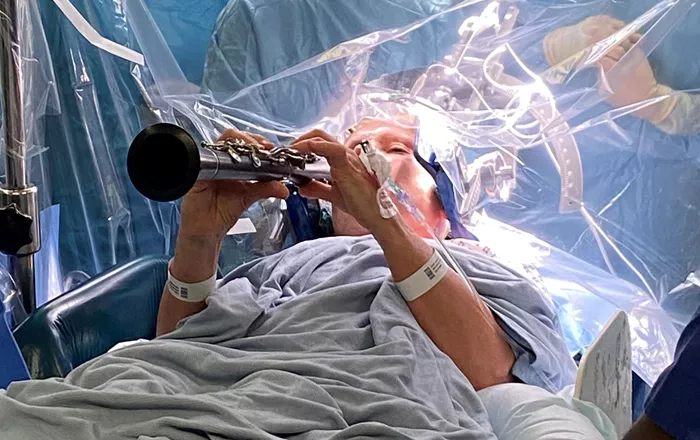
In a remarkable display of medical precision and human resilience, a 65-year-old woman with Parkinson’s disease played the clarinet during her brain surgery at King’s College Hospital in London. Denise Bacon, a retired speech and language therapist from Crowborough, East Sussex, underwent Deep Brain Stimulation (DBS), a complex neurosurgical procedure designed to help control movement-related symptoms of Parkinson’s disease.
As the operation progressed, Denise’s ability to play her clarinet became a live demonstration of the immediate and tangible effects of brain stimulation. Surgeons could both see and hear her improvement as the procedure unfolded — an extraordinary real-time validation of medical success.
A Life Interrupted by Parkinson’s Disease
Diagnosed with Parkinson’s disease in 2014, Denise had battled classic symptoms of the condition for years. The degenerative neurological disorder caused her bradykinesia (slowness of movement) and rigidity (muscle stiffness), which increasingly interfered with her daily life. Activities she once loved — walking, swimming, dancing, and especially playing the clarinet — had become progressively difficult.
Her diagnosis and gradual decline led to her stepping away from the East Grinstead Concert Band, where she had played for years. The physical limitations imposed by Parkinson’s robbed her not only of mobility but also of an essential form of self-expression through music.
Inside the Operating Theatre: A Four-Hour Ordeal
The four-hour surgery was led by Professor Keyoumars Ashkan MBE, Professor of Neurosurgery at King’s College Hospital, and one of the UK’s leading experts in Deep Brain Stimulation. The multidisciplinary team also included a neurologist, neuropsychologist, and a specialized group of DBS and theatre nurses.
The procedure involved implanting thin electrodes into precise areas of Denise’s brain responsible for motor control. These electrodes were connected to a small pulse generator, similar in design to a pacemaker, which sends controlled electrical impulses to modulate abnormal brain activity and alleviate Parkinson’s symptoms.
Denise was awake for the surgery under local anaesthetic — her scalp and skull were numbed, but her brain, lacking pain receptors, felt no discomfort. Remaining conscious allowed surgeons to monitor her reactions and symptoms in real time, a critical aspect of the operation’s success.
Precision and Progress: How Deep Brain Stimulation Works
Explaining the procedure, Professor Ashkan described how a stereotactic frame was attached to Denise’s head to guide the surgical team with pinpoint accuracy.
“Holes half the size of a five pence piece were made in Denise’s skull after a frame with precise coordinates was placed on her head, acting as a sat nav to guide us to the correct positions within the brain,” he said.
Once the electrodes were positioned, electrical stimulation was initiated. Almost immediately, the medical team observed visible improvements in the movement of Denise’s fingers — a clear sign of restored motor control. When the right side of her brain was stimulated, her left hand’s mobility improved, and vice versa.
To assess the real-world impact of the stimulation, the team encouraged Denise to play her clarinet right there in the operating theatre. The moment was both clinical and emotional: her playing grew smoother, her fingers more agile, and her expression filled with relief and joy.
“As a keen clarinettist, Denise wanted to see if this would help her play again. We were delighted to see an instant improvement once stimulation was delivered,” Professor Ashkan added.
A Remarkable Recovery and Renewed Hope
Reflecting on her experience, Denise described the transformation as immediate and deeply moving.
“I remember my right hand being able to move with much more ease once the stimulation was applied, and this in turn improved my ability to play the clarinet,” she said. “I’m already noticing improvements in my walking, and I can’t wait to return to swimming and dancing.”
Denise also opted for an advanced, rechargeable pulse generator implanted in her chest. This device can last up to 20 years before requiring replacement and provides continuous electrical stimulation to the brain. It also features adaptive technology that monitors brain activity and automatically adjusts output as needed — a key innovation in personalized neurostimulation therapy.
The Broader Significance of the Surgery
Deep Brain Stimulation has been a transformative treatment for patients whose Parkinson’s symptoms do not respond adequately to medication. The surgery’s success depends on precise targeting of brain structures and ongoing adjustment of stimulation parameters.
While DBS does not cure Parkinson’s disease, it can significantly improve quality of life by reducing tremors, rigidity, and slowness of movement. Denise’s case, however, stands out not only for its medical precision but for its symbolic power — demons trating that even amid illness, the harmony between science and art can create moments of profound human triumph.
Conclusion
Denise Bacon’s performance in the operating room is likely to be remembered as one of the most striking illustrations of how neuroscience and patient-centered care can intersect. By turning her surgery into a musical collaboration between surgeon and patient, she helped show the world that healing can be both scientific and deeply personal.
Her renewed ability to make music represents more than symptom relief — it’s a restoration of identity, creativity, and hope for thousands living with Parkinson’s disease.
Related topics
