
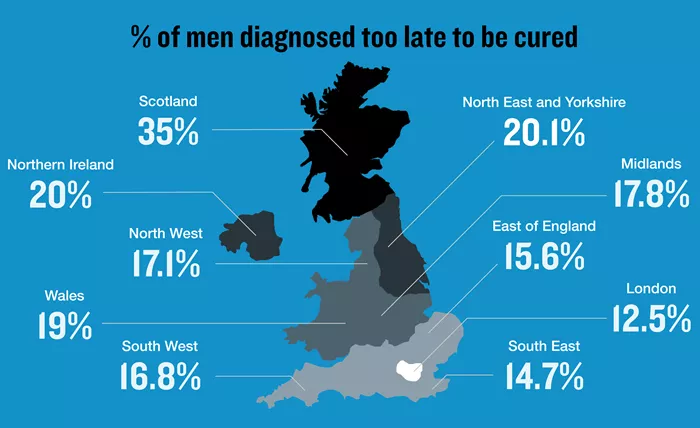
A recent comprehensive study has revealed stark regional disparities in prostate cancer diagnosis across England, with men in some areas nearly twice as likely to be diagnosed at an advanced, often terminal stage.
This first-of-its-kind investigation, analysing over 212,000 cases between 2015 and 2019, found that men living in Devon and Cornwall, along with parts of Yorkshire, the North East, and Cumbria, fare the worst when it comes to late-stage prostate cancer diagnosis.
In contrast, London, Kent, Medway, Dorset, Hampshire, and the Isle of Wight have the lowest rates of advanced prostate cancer at diagnosis.
The data highlights that in regions with fewer overall prostate cancer diagnoses, a disproportionate number of men are diagnosed only after the cancer has spread beyond the prostate, significantly lowering survival chances. This disparity is believed to be largely due to differences in access to or uptake of prostate-specific antigen (PSA) blood testing, which can detect prostate cancer early.
Currently, the UK does not have a formal prostate cancer screening program, making early detection highly dependent on whether men seek tests and whether GPs offer them. Many general practitioners hesitate to offer PSA tests, particularly to men under 50 or without a family history, and men often need to request testing themselves.
Health Secretary Wes Streeting called the findings “deeply troubling” and said they expose “unacceptable inequalities” in healthcare. In response, the government is reviewing the possibility of introducing targeted screening for men at higher risk, such as Black men and those with a family history of prostate cancer. The UK National Screening Committee is prioritizing the evidence review on this matter.
Prostate cancer remains the most commonly diagnosed cancer in men in the UK, with approximately 55,000 new cases and 12,000 deaths annually. Early-stage diagnosis boasts nearly 100% five-year survival rates, but this drops to about 50% once the cancer metastasizes.
Previously, the UK rejected screening programs due to concerns about PSA test reliability and the risk of unnecessary invasive procedures. However, advances in diagnostic technologies, including imaging and biopsy techniques, have improved accuracy. Ongoing clinical trials aim to determine if screening could reduce prostate cancer deaths by up to 40%.
Charity Prostate Cancer UK has criticized current NHS guidelines, which they describe as outdated and confusing, as a barrier to proactive GP engagement on prostate cancer risk. They advocate for guideline changes that empower doctors to initiate conversations about PSA testing, especially for high-risk groups, rather than waiting for men to request it.
Experts stress that a man’s postcode currently influences the likelihood of late prostate cancer diagnosis more than it should, urging immediate policy changes to level the playing field. With better screening and awareness, many lives could be saved by catching prostate cancer earlier, before it becomes incurable.
Read more:
