
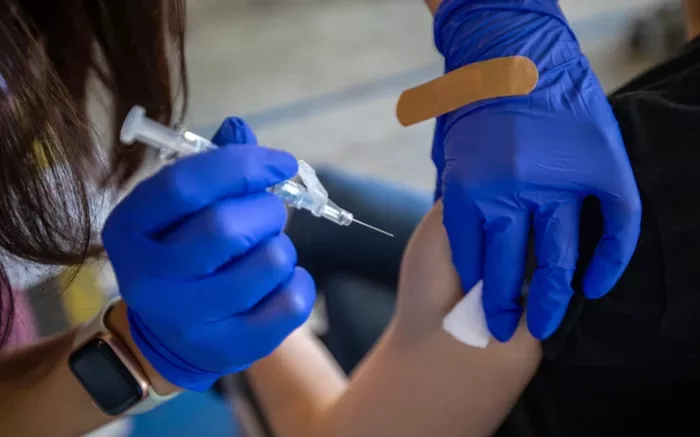
As the summer progresses, COVID-19 cases are showing an upward trend across the United States, prompting questions about personal risk levels and the necessity of a new vaccine.
According to the Centers for Disease Control and Prevention (CDC), as of July 15, COVID-19 cases were either growing or likely growing in 27 states, including Texas, Illinois, Kentucky, Virginia, and Ohio. In recent weeks, the rates of positive COVID-19 tests have also been on the rise, particularly in the southern region of the country.
The current dominant variant in the United States is N.B.1.8.1, which accounts for 43% of all new COVID-19 cases, as reported by the CDC. This variant is an offshoot of the XVD.1.5.1 strain and a descendant of the omicron variant. Earlier this year, N.B.1.8.1 was responsible for a significant increase in hospitalizations in China.
Some people have reported experiencing painful sore throats, leading to the nickname “razor blade throat” for this variant, said Dr. William Schaffner, an infectious disease expert at Vanderbilt University Medical Center in Nashville, Tennessee. However, Schaffner also noted that sore throats have been a common symptom of COVID-19 since its initial spread. “I doubt the clinical spectrum of COVID has changed substantially,” he added.
Do I Need a COVID-19 Booster?
The increase in cases comes at a time when many Americans may have gone a year or more without receiving a COVID-19 vaccine. In May, the Food and Drug Administration (FDA) requested that drugmakers update their COVID-19 vaccines to target the LP.8.1 strain, a descendant of JN.1. JN.1 began spreading widely in 2023 and is another offshoot of the omicron variant. Currently, LP.8.1 accounts for 31% of all new cases, according to the CDC.
The new vaccines are not expected to be available until the fall. They are likely to be approved only for adults 65 and older, as well as kids and adults with at least one medical condition that puts them at risk of severe illness. Healthy kids and adults who wish to get a shot may need to find an older version or pay out-of-pocket, with a single dose potentially costing up to $140.
However, experts suggest that population immunity, whether from vaccination, prior infection, or both, may offer some protection to the general public for now. “While we don’t have a high level of immunity in the population right now, because it’s been so long, we may have enough low-level immunity to make it a bit harder for the virus to spread easily from person to person,” said Andy Pekosz, an infectious disease researcher at Johns Hopkins University.
Indeed, weekly hospitalization rates have remained low, indicating that the new variant may not be causing severe illness. The number of cases is still significantly lower than at the same time last year, when the test positivity rate peaked at 17.9% in August. So far in 2025, the rate has not exceeded 5%.
Pekosz said it is not uncommon for cases to increase during the summer, as people often gather indoors to escape the heat. However, he believes that if there is a summer surge in cases, it will likely be a small one. “The variants have been around for a while and haven’t caused any major surges until now,” Pekosz said. “So again, I’m hopeful that if we see a surge, it’ll be a low-level one compared to previous years.”
Dr. Ofer Levy, director of the precision vaccines program at Boston Children’s Hospital and an advisor to the FDA, said that people at high risk of severe illness may still want to consider getting a COVID-19 shot if they can find one. High-risk groups include older adults, people with weakened immune systems, pregnant women, and those with underlying health conditions such as asthma and heart disease.
Levy emphasized that getting a shot is particularly important for those who haven’t had one in over a year and whose immunity has likely decreased. “If you’re in a high-risk group and you’re in a state where cases are rising, you may want to take the first available appointment and get a shot to protect yourself,” he said. He also suggested that high-risk individuals could consider getting an additional COVID-19 shot when the updated vaccines are distributed in the fall.
COVID-19 Has Two Waves a Year
Dr. William Schaffner of Vanderbilt University also recommended that people in high-risk groups consider wearing masks during indoor activities, such as going to the movies. Dr. Michael Phillips, an infectious disease doctor at NYU Langone, said that most of the positive cases he sees are among immunocompromised and older adults. For those who haven’t received a COVID-19 shot in years, Phillips said they don’t need to worry just yet. “If you’re younger and otherwise healthy, I think you’re okay,” Phillips said. “But if you have underlying pulmonary disease or are in an older age group, that’s when you should really talk to a doctor and ask, ‘Should I be getting a booster for COVID-19?’” He also noted that the number of positive COVID-19 tests at NYU Langone has decreased by 40% since February.
Fatima Amaeka, a senior analyst at the Center for Outbreak Response Innovation at Johns Hopkins, said she anticipates the current wave to peak around September. Dr. Schaffner said to expect another wave in the late fall and winter. “[COVID-19] has two increases each year,” he said. “Everyone is familiar with the winter increase that coincides with flu and RSV.”
READ MORE
