
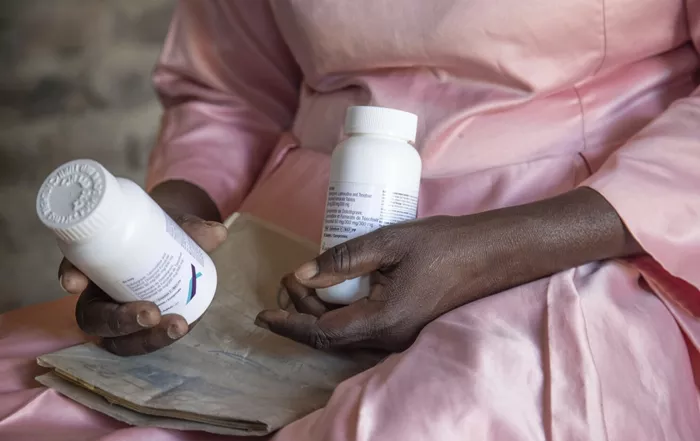
Gugu, a 54-year-old South African woman living with HIV, once relied on a USAID-funded clinic in Johannesburg to get her antiretroviral medication. But when U.S. aid was cut earlier this year under President Donald Trump, that lifeline disappeared.
She was one of the fortunate ones. Before her clinic shut its doors, staff gave her a nine-month supply of medication — enough to last until September. After that, she plans to turn to her local public hospital, though she worries about what comes next.
“I used to collect a three-month prescription, but before my clinic closed, they gave me enough until September,” she said. “Then I’ll go to the hospital.”
Gugu, a former sex worker, was diagnosed with HIV a decade ago after a persistent cough led her to seek testing. Today, she works as a project coordinator for an NGO supporting pregnant sex workers, helping them stay on treatment to prevent transmission to their babies.
Her concern now is not just for herself, but for the thousands who depended on similar clinics. Many sex workers preferred the privacy and accessibility of U.S.-funded centers. With those gone, public hospitals are their only option — and they come with major challenges.
“Sex workers don’t have the luxury of time,” she said. “At public hospitals, you have to show up at 4 or 5 a.m. and spend the whole day waiting. For them, time is money.”
She also worries about stigma. On a recent visit to her local hospital, a nurse dismissed her concerns, saying, “There’s nothing special about sex workers.” That kind of treatment, she said, could push many to stop taking their medication altogether.
Cuts Threaten Global HIV Progress
The impact of U.S. aid cuts goes far beyond South Africa. In a report released Thursday, UNAIDS warned that major funding reductions by several countries could reverse years of global progress in fighting HIV and AIDS.
According to the report, new HIV infections have dropped by 40% since 2010, and more than 4 million children have been protected from the virus since 2000. Over 26 million lives have been saved. But the agency warns that without immediate action, six million more infections and four million AIDS-related deaths could occur by 2029.
Before this year’s cuts, both new infections and deaths had dropped to their lowest levels in more than three decades. Sub-Saharan Africa — still the epicenter of the epidemic — had achieved a 56% reduction in new cases. Countries like Lesotho, Malawi, Rwanda, and Zimbabwe were on track to cut infections by 90% by 2030.
South Africa, home to the world’s largest HIV-positive population at 7.7 million, has seen similar success. With 5.9 million people on antiretrovirals, AIDS-related deaths have fallen by 66% since 2010.
Much of that progress came from PEPFAR — the President’s Emergency Plan for AIDS Relief — launched by George W. Bush in 2003. Over the last two decades, PEPFAR invested more than $100 billion into global HIV efforts. In South Africa alone, it accounted for 17% of HIV program funding, helping run mobile clinics and expand treatment access.
Now, experts fear those gains are at risk.
“We’re Losing Momentum”
“We were getting on top of this,” said Professor Lynn Morris, Deputy Vice-Chancellor of Johannesburg’s Wits University. “Now, I think we’ll start seeing more HIV infections, more TB cases, and more infectious diseases overall.”
For people like Gugu, treatment is a matter of survival.
“People don’t skip their meds because they want to,” she said. “They’re scared. If they don’t take ARVs, they could die.”
The cuts have also disrupted critical research, including efforts to develop an HIV vaccine. South Africa has long been a global leader in HIV science, hosting major trials for prevention drugs like PrEP and Lenacapavir, a twice-yearly injection offering full protection.
At Wits University, Associate Professor Abdullah Ely leads a team in the Brilliant Consortium — a group working across eight African nations to develop a homegrown HIV vaccine. But the U.S. funding freeze brought their project to a halt.
“When the stop order came, everything stopped,” Prof. Ely said. “Some of us found alternative funding, but we’ve lost months — maybe a year.”
Their lab lacks the money to begin human trials, and that means future breakthroughs may no longer be African-led.
“That’s a huge loss for South Africa and the continent,” Ely said. “It means future research will be tested in the U.S. or Europe.”
“We’re Leading, But Not for Ourselves”
In June, South African universities asked the government for 4.6 billion rand (about $260 million) to make up for lost U.S. funding. The plea was urgent, said Dr. Phethiwe Matutu of Universities South Africa.
“South Africa leads in HIV research, but not for itself,” she said. “This will affect global policies and treatment.”
On Wednesday, Health Minister Aaron Motsoaledi announced new support: 100 million rand each from the Bill and Melinda Gates Foundation and the Wellcome Trust, along with 400 million rand from the government over three years. That totals 600 million rand — far short of what researchers say is needed.
Hopes for the Future Dimmed
Gugu had once believed a cure would come in her lifetime. Now, she isn’t so sure.
“I’m raising a nine-year-old boy. I want to live as long as I can for him,” she said. “But this isn’t just about now. It’s about the next generation — of women, of young people. What kind of future will they have if we let this progress slip away?”
READ MORE
8-Year-Old Boy With Rare Disease Improves After New Treatment
Improving Sleep and Lifestyle Lowers Heart Disease Risk in Menopausal Women
