
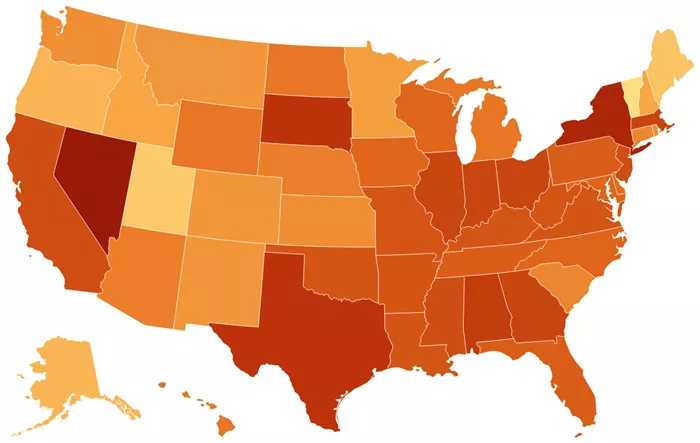
A recent large-scale psychological study has uncovered significant differences in the prevalence of dark personality traits—such as psychopathy, narcissism, Machiavellianism, and sadism—across U.S. states. Based on responses from over 144,000 Americans, researchers have mapped where these traits are more common, offering insights into how environment and social factors may influence personality.
Understanding the “Dark Factor” of Personality
Psychologists Morten Moshagen, Benjamin E. Hilbig, and Ingo Zettler introduced the concept of the “dark factor” (D), a unified measure that captures the overlap between various socially aversive traits. Similar to the general intelligence factor (“g”), the D factor reflects a dispositional tendency toward behaviors like manipulation, exploitation, and a willingness to harm others for personal gain.
Importantly, individuals with high D scores are not inherently “evil,” but they tend to view the world as a competitive and harsh place, sometimes deriving satisfaction from others’ misfortune. These traits can manifest in everyday life, influencing workplace dynamics, social interactions, and ethical decision-making.
Which States Have the Most “Dark” Personalities?
The study found Nevada leads the nation with the highest average D score of 2.26 out of 5, closely followed by New York (2.24), Texas, and South Dakota (both 2.22). Conversely, Vermont scored the lowest at 1.96, the only state with an average below 2, followed by Utah (2.03) and Maine (2.04).
While the numerical differences might seem modest, they are statistically significant when considering large populations. These findings do not label individuals but suggest that certain dark traits may be more socially accepted or even rewarded in some regions.
The Role of Environment and Social Conditions
The researchers also explored how social adversity correlates with dark personality traits. By integrating data on corruption, inequality, poverty, and violence, they observed that people living in more challenging environments tend to exhibit higher levels of these traits.
This suggests that environmental factors play a crucial role in shaping personality, potentially encouraging behaviors that prioritize self-interest and competition over cooperation and empathy.
Practical Takeaways for Everyday Life
Awareness: Recognize that dark personality traits exist on a spectrum and can influence everyday interactions.
Context Matters: Social and environmental factors can shape how these traits manifest, so understanding your community’s dynamics is important.
Healthy Boundaries: In environments with higher prevalence of dark traits, setting clear personal and professional boundaries can protect your well-being.
Promote Empathy: Encouraging kindness, fairness, and transparency in your social circles and workplace can help counterbalance negative tendencies.
By understanding the interplay between personality and environment, individuals and communities can foster healthier, more supportive social climates.
Related topics:
