
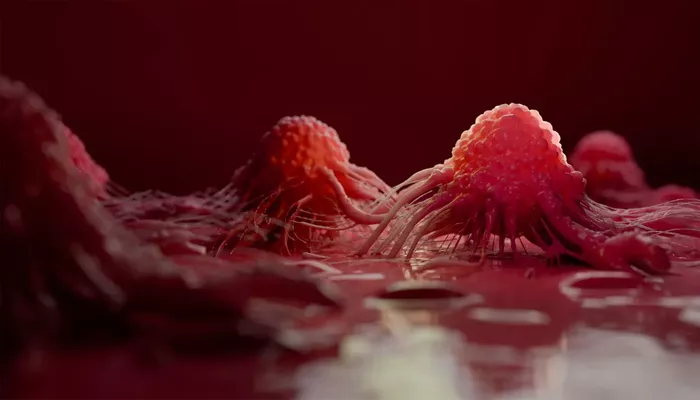
Researchers at the Herbert Irving Comprehensive Cancer Center (HICCC) have identified a key mechanism that allows prostate cancer cells to resist the latest treatments. Their study, published in Nature, resolves a longstanding question in tumor biology and presents preclinical evidence for a drug that could soon enter clinical trials.
The research stems from decades of work by Michael Shen, PhD, co-leader of HICCC’s Tumor Biology and Microenvironment program. Shen studies lineage plasticity—the ability of cancer cells to reprogram themselves to mimic other cell types.
“Plasticity is a hallmark of cancer and plays a major role in advanced prostate cancer, especially in treatment resistance,” Shen says. Androgen receptor inhibitors, a standard therapy, often prompt tumor cells to adopt neuroendocrine characteristics, making them resistant.
Earlier work by Jia Li, an associate research scientist in Shen’s lab and first author of the new paper, revealed that these changes are epigenetic, not genetic—they alter gene expression without changing DNA. This led Shen to collaborate with Chao Lu, PhD, co-leader of HICCC’s Cancer Genomics and Epigenomics program. Lu’s team analyzed how tumor cells modified their histones, DNA-binding proteins that regulate gene activity.
In a striking coincidence, the histone modification pathway most involved in lineage switching was one Lu had been studying for years. “It was gratifying that our pathway emerged as the top regulated modification in neuroendocrine versus non-neuroendocrine prostate cancers,” Lu says.
However, the next challenge was formidable. The enzyme responsible, NSD2, had long been considered “undruggable.” Peer-reviewed journals required evidence that a drug could inhibit NSD2 to prove its role in lineage plasticity. The team first shared their findings on bioRxiv, a public preprint server, while seeking a solution.
At the same time, pharmaceutical company Novartis developed small molecules capable of inhibiting NSD2. Shen, Lu, and collaborators synthesized one of these inhibitors and tested it in organoids and animal models. The drug reversed the neuroendocrine phenotype in tumors. While this alone did not kill cancer cells, combining it with androgen receptor inhibitors proved synergistic—one drug attacked the cells while the other made them vulnerable by altering their lineage.
Importantly, the study showed that this plasticity-driven resistance can be reversed. Tumors that had shifted to a neuroendocrine, drug-resistant state could be pushed back to a more typical prostate cancer identity, making them sensitive to hormone therapy again. This is among the first demonstrations that epigenetic plasticity–driven treatment resistance can be reset, not just bypassed.
Since lineage plasticity occurs in many cancers, the approach may have broader applications. “We are already exploring whether NSD2 plays a similar role in small cell lung cancer,” Shen says.
Related topic:
