
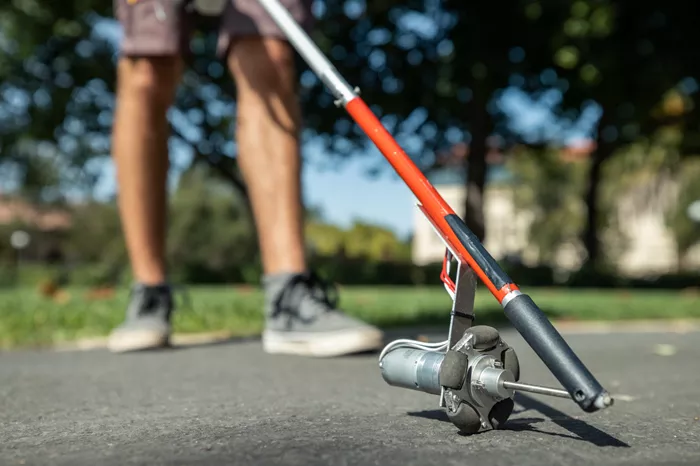
Graduate students and researchers from North Carolina Central University (NCCU) are pioneering advancements in assistive technology through their exploration of smart canes—innovative tools designed to help individuals who are blind or visually impaired navigate their environments more safely and independently.
Traditionally, standard folding canes have served as vital mobility aids, enabling users to detect obstacles directly in their path, particularly those at ground level. However, these canes often fall short in identifying higher or more complex obstacles. NCCU’s new research seeks to bridge that gap by introducing technology that offers comprehensive, full-body protection and interactive features to enhance user awareness and confidence.
Beyond the Traditional Cane: Smart Canes and Their Capabilities
Dr. Sean Tikkun, Associate Professor at NCCU and the project’s lead investigator, emphasized that the new smart cane technology represents a major leap forward in safety and functionality.
“So if you have a low-hanging branch or if you have a sign—as we do in Raleigh, where we’re conducting our training—you can get early warning from that device that something’s in that upper range,” Tikkun explained. “It doesn’t just protect the lower part of the body—it protects the upper as well.”
The smart canes being tested are designed by WeWalk, a Turkish technology company specializing in assistive devices for the visually impaired. These canes integrate a voice assistant, built-in speakers, a microphone, and a flashlight, transforming a simple mobility tool into an interactive, data-driven system that can connect seamlessly with smartphones and navigation apps.
How the Smart Cane Works
Each WeWalk smart cane is equipped with multiple sensors that help detect a variety of obstacles, from uneven surfaces to overhead hazards. The device provides real-time feedback through vibrations, auditory cues, and voice guidance, allowing users to make instant navigational decisions.
Users can connect their canes to their iPhones via Bluetooth, enabling hands-free control of navigation apps, and access to public transit information, or directions through voice commands. The technology even allows researchers like Tikkun to monitor real-time data across multiple users.
“For the company, what we’re doing is applying the technology—we’re testing out their platform,” said Tikkun. “I can log in and pull up data for each of my students’ canes, which are spread out across four states, and see how much they walked this week.”
This integration of data analytics and mobility training offers valuable insights into user behavior, travel patterns, and environmental challenges faced by people with visual impairments. It also helps researchers fine-tune the technology to better serve user needs.
Funded Innovation and Long-Term Vision
The project is backed by a $1.25 million grant from the U.S. Department of Education, distributed over five years. This substantial funding supports both the acquisition of devices and the research infrastructure needed to analyze user data, train participants, and assess the broader social and psychological impacts of the technology.
Through this research, NCCU aims to contribute not only to academic understanding but also to real-world applications that could transform how the visually impaired navigate their daily lives.
Tikkun and his team envision a future where smart canes are widely adopted, becoming as commonplace and essential as traditional canes. The ultimate goal is to create a world where technology empowers rather than limits—offering greater autonomy, safety, and quality of life for people with vision loss.
Bridging Research, Technology, and Accessibility
The NCCU project represents a broader shift toward inclusive innovation, where academic institutions partner with global tech developers to address real human needs. By combining engineering, data science, and accessibility research, the team is helping redefine what it means to live independently with a disability.
Smart cane technology is still evolving, but its potential impact is profound. As devices become more refined, affordable, and accessible, they promise to revolutionize how people with visual impairments interact with their environments—making cities, campuses, and communities more navigable for all.
For NCCU, this research marks more than just a scientific achievement—it’s a testament to how technology and empathy can merge to improve everyday life. As Dr. Tikkun and his graduate students continue to test, analyze, and refine smart cane systems, they’re not just collecting data—they’re building pathways to a more inclusive and connected future.
Related topics
