
Former President Donald Trump has issued a sharp directive to more than a dozen of the world’s largest pharmaceutical companies, demanding they significantly cut the price of prescription medications in the United States within 60 days or face unspecified government action.
In a series of letters posted Thursday on his social media platform, Truth Social, Trump instructed drugmakers to align their U.S. pricing with international benchmarks — a strategy modeled on the “most favored nation” rule. Under this rule, companies would be required to offer Medicaid recipients the same drug prices they charge in countries with the lowest negotiated rates.
The letters also called on manufacturers to ensure that all newly approved drugs are launched in the U.S. at the same lower prices offered abroad, with those pricing standards maintained over time. Trump further demanded that drugmakers rebate any excess revenue earned overseas back to American taxpayers, and introduce a direct-to-consumer model offering select drugs at reduced prices.
“Make no mistake: a collaborative effort towards achieving global pricing parity would be the most effective path for companies, the government, and American patients,” Trump wrote. “But if you refuse to step up, we will deploy every tool in our arsenal to protect American families from continued abusive drug pricing practices.”
The ultimatum was delivered to 17 pharmaceutical companies, including industry giants Eli Lilly, Pfizer, Merck, Johnson & Johnson, GSK, Amgen, Novo Nordisk, and Novartis. Trump’s demand echoes his long-standing criticism that Americans pay significantly more for prescription medications than citizens in other developed countries.
According to RAND Corporation, prescription drug prices in the U.S. can be up to 10 times higher than in comparable nations. A recent KFF poll found that more than 75% of American adults consider prescription drugs unaffordable.
Still, health policy experts say Trump may be limited in what he can accomplish without new legislation from Congress.
“It may take more than a tough letter from the President to motivate the pharmaceutical industry to drop their prices,” said Tricia Neuman, executive director of Medicare policy at KFF. “The voluntary approach hasn’t worked so far. Drug prices tend to go down when compelled by law or in response to market competition.”
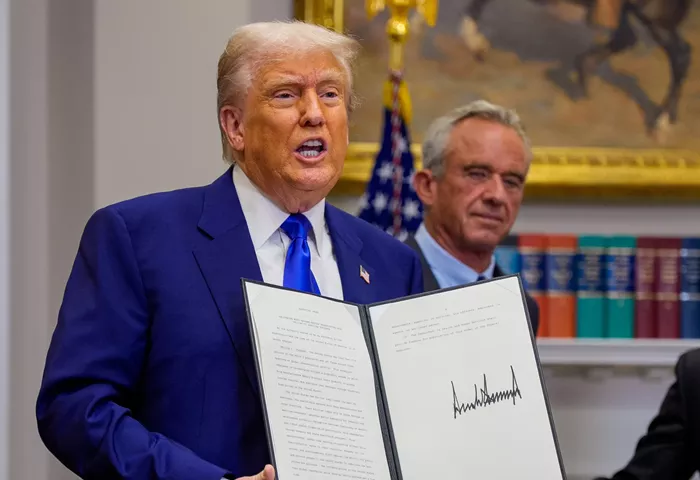
The letters come just months after Trump signed an executive order in May directing federal health officials to renew efforts to implement the “most favored nation” rule — a move that failed during his first administration.
A spokesperson for Novo Nordisk responded to NBC News, saying the company “remains focused on improving patient access and affordability” and is committed to finding workable solutions. Eli Lilly confirmed receipt of the letter but deferred comment to the Pharmaceutical Research and Manufacturers of America (PhRMA), which did not immediately respond.
Meanwhile, some pricing relief is already in motion under the Biden administration. The Inflation Reduction Act — passed in 2022 — gave Medicare the authority to negotiate directly with drugmakers over the cost of select high-cost drugs. The first round of negotiated prices is projected to save Medicare $6 billion in 2026 when those reductions take effect.
Whether Trump’s aggressive messaging strategy will move the needle remains to be seen. But his actions highlight the enduring political and public pressure to rein in America’s soaring drug costs — a top concern for voters across the political spectrum.
READ MORE:
