
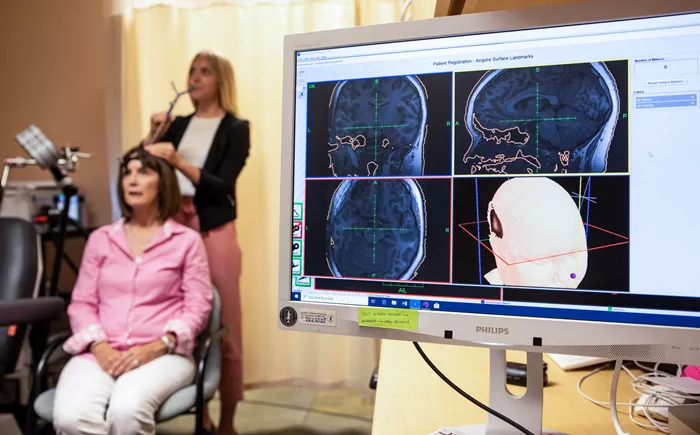
A new brain stimulation treatment is providing hope to patients struggling with severe, treatment-resistant depression — a condition affecting nearly one in five adults in the United States over the course of their lives.
While psychotherapy and antidepressant medications bring relief for many, they don’t work for everyone. Some patients continue to experience debilitating symptoms like persistent sadness, insomnia, feelings of guilt or worthlessness, and even suicidal thoughts — despite trying multiple treatments.
“For some, nothing seems to work,” said Dr. Nick Trapp, assistant professor of psychiatry at the University of Iowa. “These individuals are stuck in a cycle of suffering that traditional treatments can’t break.”
Now, an innovative approach known as Stanford Accelerated Intelligent Neuromodulation Therapy, or SAINT®, is changing that narrative.
How SAINT® Works: A Non-Invasive Reboot for the Brain
SAINT uses transcranial magnetic stimulation (TMS) — a non-invasive technology that applies electromagnetic pulses to specific regions of the brain. These pulses stimulate neural activity and promote brain “remapping,” a process crucial for treating depression.
In cases of major depressive disorder, researchers have identified low activity in the left dorsolateral prefrontal cortex, a region located just behind the forehead. By delivering magnetic pulses to this area, SAINT essentially “wakes up” the underactive neurons, restoring normal function.
“This therapy makes your brain more able to remap itself,” explained Dr. Trapp. “Normally the brain resists such changes, but when it’s stuck in a pathological state, we need to encourage new pathways.”
Unlike antidepressants, which influence chemical messaging in the brain, SAINT targets the brain’s electrical impulses — the same natural electrical signals neurons use to communicate.
“TMS and SAINT use electromagnetic fields to induce electrical energy directly in the brain tissue, encouraging neurons to fire,” said Trapp.
Simple, Comfortable, and Pain-Free Treatment
Patients undergoing SAINT sit comfortably in a reclining chair. A specialized coil, resembling a waffle iron, is placed next to the head. This coil emits magnetic pulses through the skull, reaching the brain painlessly. Most patients report only a tapping sensation during the procedure, and unlike some treatments, SAINT carries no cognitive side effects, such as memory loss or confusion.
Treatments are administered daily, typically over a span of six weeks. But SAINT’s advanced design now offers a faster alternative.
From Six Weeks to Five Days: The Power of Precision
What sets SAINT apart is its speed and precision. Traditionally, clinicians estimated treatment targets based on skull measurements. With SAINT, however, patients receive a pre-treatment MRI scan, allowing physicians to pinpoint the precise location in the brain requiring stimulation.
“Using imaging to guide the treatment has improved precision tremendously,” said Trapp. “We know exactly where to direct the pulses.”
Moreover, SAINT condenses what was once a 40-minute session into just three minutes, using a method called the theta burst protocol. Patients can now receive the full course of therapy in five consecutive days, undergoing 10 sessions per day with rest periods in between.
“They spend about 10 minutes in treatment, then relax until the next session,” said Trapp. “For those who travel long distances, this is a major advantage.”
Remarkable Results, Rapid Relief
Early results are promising. Trapp reported that over 80% of patients achieved remission of their depression symptoms within a month of starting treatment. Many begin to feel better within just two to three days.
Though not a permanent cure, SAINT can be repeated every six months to two years, as needed. Patients who responded well to the initial treatment tend to benefit from subsequent sessions as well.
“We see some of the sickest patients — those who have tried everything else,” Trapp said. “And it’s amazing to see them finally get relief.”
A Game-Changer in Mental Health Treatment
The University of Iowa is among the first academic medical centers in the country to offer SAINT therapy, thanks to Dr. Trapp’s experience working directly with its developers at Stanford University.
“We’re proud to bring this to patients who truly need it,” said Trapp. “Our mission is to provide hope and innovative solutions. SAINT is doing exactly that.”
While SAINT is still being adopted gradually, many psychiatrists see its potential as a future standard treatment for depression, alongside medications and talk therapy.
READ MORE
Zurzuvae Offers Fast Postpartum Depression Relief, Not a Cure for All
New Research Uncovers How Ketamine Treats Depression
UK Sees 85,000 New Mothers Affected by Postnatal Depression: Warning Issued
