
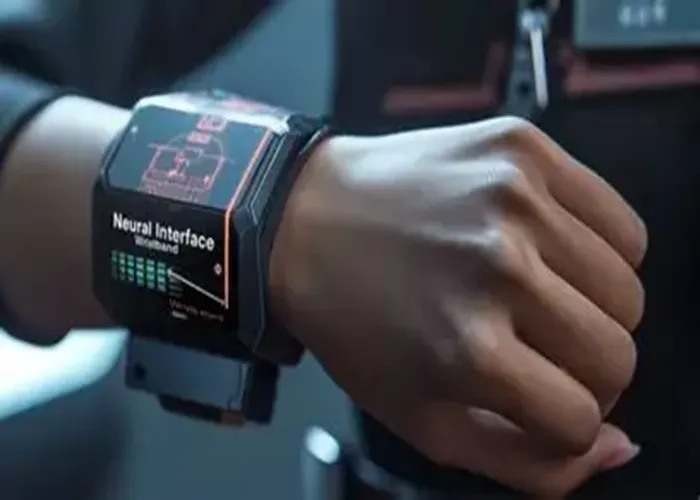
On July 23rd, Nature reported that Meta, an American company, has launched a new neuromotor wristband that enables users to interact with computers through hand gestures such as handwriting movements. This device converts the electrical signals generated by muscle movements in the wrist into computer commands, without the need for personalized calibration or invasive surgery. This achievement marks a significant advance in the application of high – performance biosignal decoders, making human – computer interaction smoother and expanding the scale of accessibility.
Traditional ways of human – computer interaction with devices like computers and mobile phones involve direct contact with input devices such as keyboards, mice, and touchscreens. These interactions have limitations, especially in “mobile scenarios”.
A team from Meta’s Reality Labs developed a highly sensitive wristband using the training data of thousands of subjects. This wristband can detect the electrical signals of wrist muscles and convert them into computer signals. The team then created a generic decoding model using deep learning, which can accurately translate different user inputs without individual calibration.
The performance of this decoding model exhibits a “scaling law”, that is, the performance is optimized as the model architecture expands and the data increases. If personalized optimization is carried out according to specific individual data, the performance can be further improved. The results of the “scaling law” and personalization also point the way for the future widely applicable biosignal decoders.
The device communicates with the computer using a Bluetooth receiver and can recognize gestures in real – time, enabling labor – saving control of a series of computer interactions. These controls can be used to complete virtual navigation and selection tasks, as well as handwritten text input at a speed of 20.9 words per minute (the average typing speed on a mobile phone keyboard is 36 words per minute).
This neuromotor wristband provides a wearable computer communication method for people with different physical abilities. The neuromotor interface is very suitable for further research to explore the accessible applications of this technology, such as improving the interaction between people with reduced mobility, muscle weakness, finger amputation, paralysis and computers.
To promote the research on surface electromyogram signals in a larger group, the team also publicly released a database in the paper, which contains more than 100 hours of surface electromyogram signal recordings from 300 subjects for all three tasks.
This is a breakthrough achievement in the field of human – computer interaction. We may be familiar with the operation of somatosensory games, but the neuromotor wristband is very different from them in terms of accuracy and signal source, and does not rely on cameras or inertial sensors. Its application is not limited to improving the convenience of daily device control, such as virtual navigation and handwritten input. More importantly, it can provide a new wearable communication method for people with limited mobility, broadening the accessibility boundary of human – computer interaction. In addition, the surface electromyogram signal database publicly released by the research team also provides valuable resources for subsequent research, which can promote the technology to more extensive application scenarios.
Related topics:
Autism in Adults Tied to Higher Mental Health Hospitalization Rates
Students Accuse Universities of Failing on Mental Health: Who Bears the Blame?
