
The White House confirmed Thursday that President Donald Trump has been diagnosed with chronic venous insufficiency, a relatively common vascular condition, following recent concerns about bruising and swelling in his limbs.
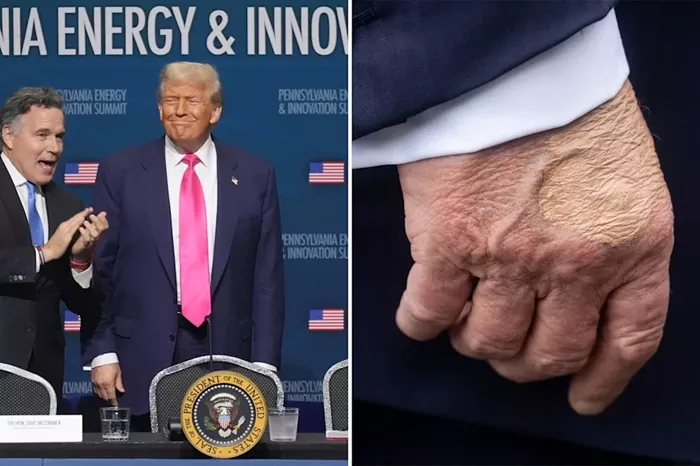
White House Press Secretary Karoline Leavitt said the 79-year-old president underwent a comprehensive vascular evaluation after photographs taken at recent public appearances — including the FIFA Club World Cup Final in New Jersey and a meeting with the Bahraini Prime Minister — revealed noticeable bruising on his hand and swelling in his legs.
According to Leavitt, the bruising on Trump’s hand was unrelated to the vein issue and instead attributed to “tissue damage from frequent handshaking” combined with his use of aspirin, a blood-thinning medication typically prescribed to reduce the risk of cardiovascular events such as heart attacks or strokes.
Understanding the Vein Condition
Trump’s recently diagnosed condition, chronic venous insufficiency (CVI), occurs when the veins in the legs struggle to pump blood back to the heart, causing blood to pool in the lower limbs. This can result in swelling, discomfort, and visible changes in the skin.
Dr. Meryl Logan, an assistant professor of vascular surgery at the University of Texas at Austin, explained that CVI involves a breakdown in the function of leg veins and valves, which normally work against gravity to push blood upward toward the heart. “When those veins and valves don’t work properly,” she said, “blood can flow backwards and collect in the legs.”
The White House emphasized that the president’s test results showed no signs of deep vein thrombosis (DVT), arterial disease, or systemic illness. According to Dr. Sean Barbabella, the official White House physician, Trump’s condition is “benign and common,” particularly among individuals over the age of 70.
Medical Experts Confirm Non-Serious Diagnosis
Dr. Matthew Edwards, chair of the Department of Vascular Surgery at Wake Forest University, agreed with the White House assessment, stating that up to 35% of older adults may experience this condition. “It can be associated with serious complications if unmanaged, but in and of itself, chronic venous insufficiency is not life-threatening,” he said.
Risk factors for CVI include aging, obesity, prolonged standing, and a history of blood clots. Medical experts recommend compression stockings, leg elevation, regular moisturization, and weight control as effective strategies for managing symptoms.
Bruising Not Related to Vein Disorder
While the diagnosis of CVI explains the leg swelling, the bruising on the president’s hand — seen most recently during handshakes with world leaders — has a different origin. Dr. Barbabella attributed the bruising to aspirin-induced fragility of blood vessels, noting that such side effects are not uncommon in elderly patients.
Dr. Edwards corroborated this, saying: “Older adults, especially those on blood thinners like aspirin, tend to bruise more easily. Combine that with firm handshakes, and it’s not surprising.”
He added, “It doesn’t take much — just a strong grip or bumping into something — to cause visible bruising when the skin and vessels are more delicate.”
No Indications of Broader Health Issues
Despite online speculation surrounding Trump’s appearance, the White House reaffirmed that the president remains in excellent health. His annual physical in April concluded that he “exhibits cognitive and physical health,” according to Dr. Barbabella.
Trump, who was sworn in for his second term in January at the age of 78 years and seven months, holds the distinction of being the oldest U.S. president ever inaugurated. He has consistently emphasized his robust health, once famously declaring himself “the healthiest president that’s ever lived.”
In light of this week’s developments, medical experts stress that while CVI and bruising may appear alarming, they are both common and manageable conditions in elderly populations — especially those under regular medical supervision.
Related topics:
What Happens if a Blood Clot in the Leg Goes Untreated?
