
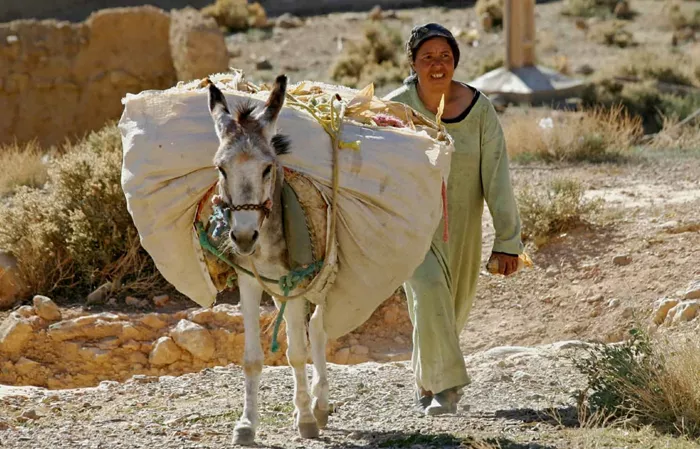
Donkeys and mules working in harsh environments may suffer from complex post-traumatic stress disorder (cPTSD), learned helplessness, and depression. This is the conclusion of a new study published in the journal Animals.
Researchers reviewed veterinary surveys conducted over 20 years in brick kilns across Egypt, Nepal, India, and Pakistan. They examined how the animals’ tough living and working conditions affect their mental health.
In light of these findings, the charity Safe Haven for Donkeys announced plans to test tractor use as an alternative to donkey labour in Egyptian brick kilns.
Andy Foxcroft, chief executive of the charity, said: “Changing mindsets will not be easy, but this study gives us strong proof to push for better treatment.”
Signs of Learned Helplessness and Trauma
The study compared the donkeys’ and mules’ behaviour with human criteria for trauma-related disorders. It also looked at environmental factors that could cause these conditions.
Results showed the animals displayed signs matching learned helplessness and cPTSD. Researchers identified five out of seven key signs of learned helplessness and three out of four signs of cPTSD in the animals.
These signs include passivity, prolonged exposure to trauma they cannot escape, fear, anxiety, heightened startle responses, and depression.
On average, 15% of the donkeys surveyed appeared apathetic or depressed. One survey even reported up to 82% showing these symptoms.
Theodora Capaldo, a psychologist and co-author of the study, explained: “Their shutdown is not stoicism but psychological devastation. It is very similar to what humans experience after trauma. We want to break the false idea of the stoic donkey and call for compassion and understanding instead.”
Physical Harm and Neglect
More than half of the donkeys and mules (53%) had scars or open wounds, often caused by poorly fitted harnesses or beatings. One survey found this number as high as 98%. Additionally, 62% of the animals were thin or very thin.
Anna Harrison, a veterinary consultant for Safe Haven for Donkeys, said: “The study confirms what many of us have seen with our own eyes. These animals are sentient — they feel pain, fear, and despair. In the kiln environment, there is no escape. Many become physically and mentally broken from the constant stress and abuse.”
Calls for Mechanised Alternatives
The paper also mentioned that kiln owners hesitate to replace donkey labour with machines due to cost and logistics. However, it argued that well-designed tractors could overcome these problems and improve the animals’ welfare.
Read more:
