
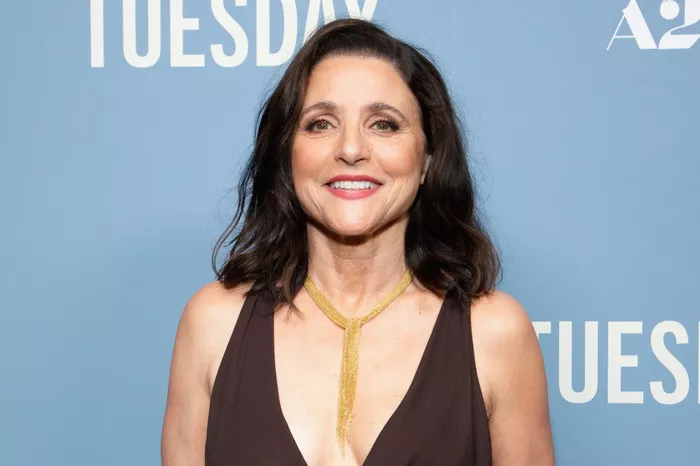
Veteran actress Julia Louis-Dreyfus turns 65 this year, marking a milestone in a career defined by resilience, reinvention, and an unwavering refusal to be sidelined — whether by industry norms or life-altering health challenges.
Best known for her iconic roles on Saturday Night Live, Seinfeld, and Veep, Louis-Dreyfus has spent more than four decades reshaping what success looks like for women in comedy. Her journey, however, has unfolded far from smoothly, shaped by professional battles, personal loss, and a very public fight with breast cancer.
Breaking Through a Male-Dominated Industry
Louis-Dreyfus’ career is often described in distinct, era-defining chapters. She broke out in the early 1980s on Saturday Night Live, became a cultural force as Elaine Benes on Seinfeld in the 1990s, and later reinvented herself as the sharp-tongued Selina Meyer on HBO’s Veep — a role that cemented her legacy as one of television’s most decorated performers.
Behind the scenes, however, her ascent came with significant resistance. She has spoken openly about navigating a male-dominated television industry and learning to assert herself early on. At one point, she said Warner Bros. pursued her for money tied to a development deal she ultimately exited, citing a creative clause that allowed her to walk away — a decision that cleared the path for Seinfeld.
“I was really scared because it was Warner Bros. and I was just this girl who was an actress,” she recalled, describing how small she felt standing up to studio executives. In the end, Louis-Dreyfus held her ground, and the studio dropped its pursuit.
Personal Loss and Motherhood
Away from the spotlight, Louis-Dreyfus faced deeply personal challenges. In the late 1980s, she and her longtime partner — now husband — Brad Hall experienced a devastating pregnancy loss. She has described the moment as emotionally shattering, compounded by a serious infection that left her hospitalized.
Support from her mother and Hall helped her navigate the grief. A few years later, she went on to welcome two sons, Henry and Charlie, whom she has often credited as grounding forces in her life.
Giving Older Women a Voice
As her career evolved, Louis-Dreyfus found new ways to connect with audiences. In recent years, she stepped into podcasting with Wiser Than Me, a series dedicated to candid conversations with older women about aging, resilience, and reinvention. The podcast was named one of Time magazine’s Top 100 Podcasts, praised for its warmth, honesty, and focus on life after hardship.
Louis-Dreyfus has said the idea was sparked by watching Jane Fonda in Five Acts, which left her reflecting on how rarely older women’s stories are given space.
“We just don’t hear from older women,” she has said — a gap she set out to change.
A Cancer Diagnosis at the Height of Success
In 2017, at what should have been a celebratory moment in her career, Louis-Dreyfus received life-changing news. Just one day after winning an Emmy, her doctor called to tell her she had stage 2 breast cancer.
She chose to share her diagnosis publicly, prompting an outpouring of support. Her treatment included six rounds of chemotherapy and a double mastectomy — a physically and emotionally demanding process that she approached with characteristic honesty and humor.
Chemotherapy, which targets rapidly dividing cancer cells, often affects healthy cells as well, leading to fatigue, nausea, hair loss, and nerve pain. Louis-Dreyfus has spoken about enduring those challenges while leaning on family, friends, and medical professionals for support.
By October 2018, she announced that she was cancer-free.
Life After Cancer
Louis-Dreyfus’ experience mirrors that of many women diagnosed with early-stage breast cancer, where treatment may involve surgery, radiation, chemotherapy, hormone therapy, or a combination of approaches. Decisions around lumpectomy versus mastectomy, reconstruction, and follow-up therapies are deeply personal and depend on factors such as tumor size, family history, and patient preference.
Beyond the physical toll, the emotional impact of a cancer diagnosis can be profound. Mental health experts emphasize that stress and fear often come in waves, making support systems — from loved ones to therapists and support groups — essential to healing.
Louis-Dreyfus has continued to work, advocate, and speak openly about survivorship, using her platform to normalize conversations around cancer, aging, and emotional resilience.
A Legacy of Strength
At 65, Julia Louis-Dreyfus stands as more than a television icon. Her story reflects a life lived with determination — pushing back against industry barriers, enduring personal loss, surviving cancer, and continuing to evolve creatively.
In real time and in full view of the public, she has shown what resilience looks like — not as a single triumphant moment, but as a lifelong practice.
