
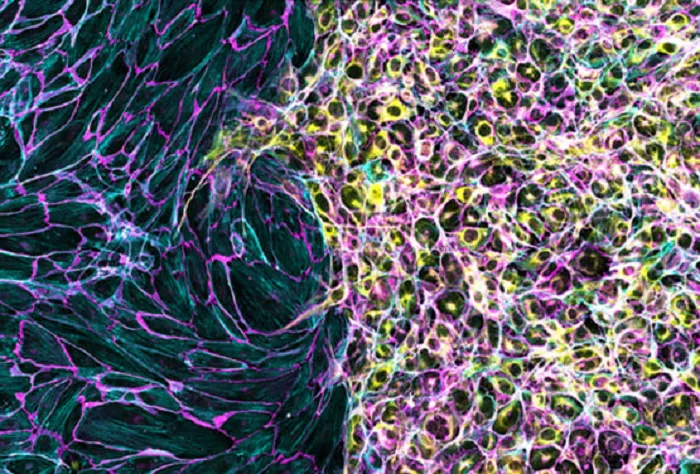
Scientists at Scripps Research have identified galectin-3 as a crucial molecule orchestrating placental development during early pregnancy, according to a study published on November 4, 2025, in Proceedings of the National Academy of Sciences.
The research reveals how this sugar-binding protein facilitates the cell fusion process essential for forming the placental barrier that sustains fetal development. These findings provide fundamental insights into pregnancy complications like preeclampsia and fetal growth restriction that arise when placental formation falters.
Molecular Mechanisms and Technical Innovation
The study employed an advanced mapping technique called proximity labeling to capture transient interactions between galectin-3 and specific cell surface proteins. This method acts as molecular “spray paint,” irreversibly marking proteins when galectin-3 binds to them.
Researchers applied this technology to human placental cells, identifying CD9 and integrin β1 (ITGB1) as key binding partners. When either protein was removed, placental cells lost their fusion capability, demonstrating their essential role in placental development.
Key Findings and Unconventional Discovery
The investigation yielded several critical insights:
- Galectin-3 consistently bound to CD9 and ITGB1 proteins decorated with specific sugar chains
- A rare glycosylation site on CD9 served as the primary binding location
- Galectin-3 molecules must cluster together to drive cell fusion
- The fusion process requires approximately 48 hours, during which membrane aggregation triggers cellular integration
“Finding such an unusual glycosylation sequence was truly exciting,” said first author Abigail Reeves, a Scripps Research graduate student. “It highlights how much we still have to learn about protein glycosylation.”
Biological Process and Structural Implications
Researchers propose that galectin-3 acts as a molecular bridge, binding to sugar-decorated CD9 proteins on multiple cells and pulling them together into a rigid structure. “We believe galectin-3 binds these CD9 glycoproteins on cell surfaces and draws them together, creating a massive, rigid architecture that facilitates fusion,” explained senior author Huang.
This process ultimately forms the syncytiotrophoblast layer essential for nutrient exchange and immunological protection during pregnancy.
Research Implications and Future Directions
The study adds to growing evidence that individual interactions between proteins and sugar chains significantly influence cellular function. The team is now working to confirm whether this process occurs in developing human placentas rather than just isolated cell lines.
This research may eventually lead to new approaches for preventing pregnancy complications by modulating galectin-3 activity. Additional plans include applying proximity labeling to other cell types to further investigate protein-sugar interactions in human biology.
Collaborative Effort and Publication Details
The research represents a collaboration between Scripps Research and University of Florida scientists, including co-authors Gil-Suk Yang, Sabyasachi Baboo, Jolene Diedrich, and others.
The study, “Mapping the placental galectin-3 interactome identifies CD9 and ITGB1 as functional glycoprotein counter-receptors in syncytialization,” provides both fundamental biological insights and demonstrates the power of new technologies for studying transient molecular interactions that have previously eluded scientific observation.
Related topics
