
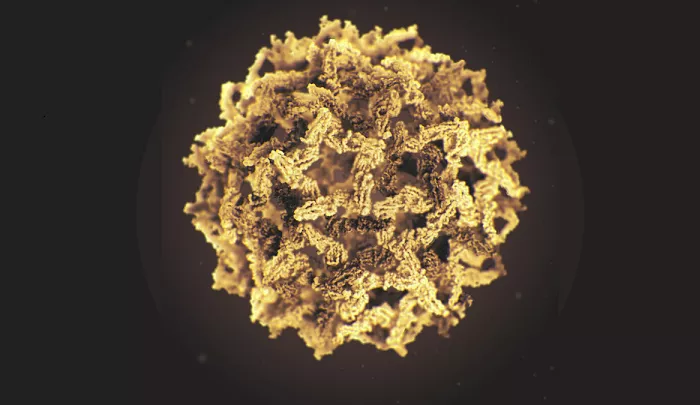
University of Queensland researchers have captured the first high-resolution images of the yellow fever virus (YFV), a mosquito-borne pathogen that causes potentially fatal liver disease.
Published in a leading scientific journal, the study reveals structural differences between the vaccine strain (YFV-17D) and virulent, disease-causing strains at near-atomic resolution. This breakthrough provides unprecedented insights into one of medicine’s most successful vaccines and opens new possibilities for improving vaccines against yellow fever and related viruses.
Technical Achievement and Methodology
Despite decades of yellow fever research, this represents the first complete 3D structural characterization of fully mature yellow fever virus particles at such detailed resolution.
The research team used advanced cryo-electron microscopy to visualize the virus’s architecture, comparing the laboratory-adapted vaccine strain with wild-type virulent strains.
Dr. Summa Bibby from UQ’s School of Chemistry and Molecular Biosciences explained, “The bumpy, irregular surface of virulent strains exposes normally hidden parts of the virus, making it easier for certain antibodies to attach, while the smooth vaccine particles cover these areas.”
Key Structural Findings
The high-resolution images revealed significant topological differences between vaccine and wild-type viruses:
- Virulent strainsexhibit uneven surfaces with exposed epitopes that facilitate antibody binding
- Vaccine strainshows a smoother surface that conceals these vulnerable regions
These structural variations fundamentally alter how the immune system recognizes and responds to the virus, helping explain why the YFV-17D vaccine has maintained exceptional efficacy since its development in the 1930s.
Implications for Vaccine Design
Professor Daniel Watterson emphasized the practical applications: “We can now pinpoint the structural features that make the current vaccine safe and effective. These findings could inform future vaccine design not only for yellow fever but also for related viruses like dengue, Zika, and West Nile.”
Yellow fever remains a significant public health concern in parts of South America and Africa, with vaccination being the primary prevention method since no approved antiviral treatments exist.
Mechanistic Insights and Immune Recognition
The structural analysis provides a mechanistic understanding of immune protection. The vaccine strain’s surface configuration creates an optimal balance between triggering protective immunity while avoiding excessive reactogenicity.
This delicate balance has made the YFV-17D vaccine one of the most effective and safest vaccines ever developed, providing lifelong immunity with a single dose in most recipients.
Future Directions and Global Health Impact
The research team is now applying these structural insights to develop next-generation vaccines against other flaviviruses. The detailed molecular blueprint of yellow fever virus may guide the rational design of broad-spectrum vaccines that protect against multiple mosquito-borne diseases.
As climate change expands the geographic range of mosquito vectors, such advanced vaccine strategies become increasingly crucial for global health security.
Related topics:
