
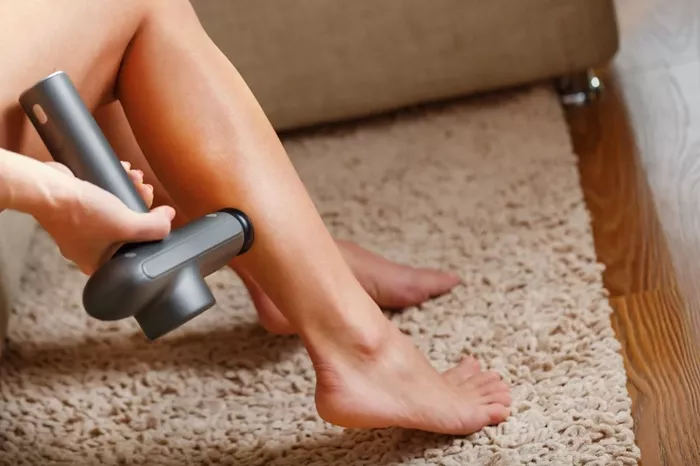
The idea that “no pain, no gain” applies to muscle recovery has long been a popular belief, particularly among those who favor deep-tissue treatments. Many individuals assume that using a massage gun at its highest intensity ensures better results. However, according to physical therapists, this approach can do more harm than good. While it might feel satisfying in the moment, excessive pressure can actually worsen pain and limit recovery.
Experts such as Jessie Duppler, DPT, creator of the Chain Reaction Strength Revolution program, and Grayson Wickham, DPT, founder of Movement Vault, emphasize that using massage guns correctly is crucial for effective muscle care. They explain that these devices serve a purpose in reducing tension and improving mobility—but only when used moderately.
How Massage Guns Actually Work
Massage guns function by stimulating sensory receptors in muscles and skin, sending signals to the brain to reduce muscle tightness and improve movement. Contrary to popular belief, they do not physically “break up” or “dissolve” knots or fascia. Wickham notes, “It would take thousands of pounds of force to deform fascial tissue—you’d practically have to run over your quad with a car.”
Instead, the massage gun engages in what experts describe as a “conversation with the nervous system.” When muscles tighten, it’s often a protective reaction from the brain, signaling the body to guard against potential injury. A massage gun’s vibrations can help relax these muscles by activating stretch receptors that tell the brain to “let go.” Duppler explains, “It can activate the stretch receptors, which send a signal to the brain saying, ‘Hey, let go of this really tight muscle.’”
Furthermore, massage guns may trigger pain receptors that override other pain signals through the pain gate theory. This process helps the body perceive less discomfort. The relaxation or euphoria experienced after an intense session can partly result from the cessation of that deep pressure stimulation.
When Massage Gun Pressure Becomes Too Intense
Although serious injury from a massage gun is uncommon, using it with excessive force can overstimulate the nervous system. Wickham cautions that intense pressure can cause the body to perceive the treatment as a threat, leading to defensive muscle tightening instead of relaxation. “Our goal with muscle and fascia release is to relax the nervous system, not stress it,” he explains.
Duppler adds that she has treated patients who developed bruising from using massage tools too aggressively. Bruising indicates damage to blood vessels and tissues—a sign that the massage is causing trauma rather than healing. While such bruises may heal, they represent an unnecessary stress on the body and counteract the intended recovery benefits.
Guidelines for Safe and Effective Self-Massage
Experts recommend keeping massage intensity at a mild discomfort level—around three on a scale of one to ten. If the massage becomes painful or intolerable, it’s too intense. Wickham advises leaning toward lighter pressure: “You might think it doesn’t seem like enough pressure, but that’s likely the sweet spot.”
For those who prefer more affordable or manual alternatives, tools like foam rollers, tennis balls, or lacrosse balls can be equally effective. By combining these tools with movement—such as bending or extending the joint near a tight muscle—you can enhance mobility through active release techniques. Still, massage alone won’t address the root cause of tightness. Duppler stresses, “Tightness is always a symptom, not a cause.” Strengthening weak areas, such as the hips for those with tight calves, is essential for long-term improvement.
Recommended Low-Pressure Massage Guns
Rally Massage Gun – $499
Unlike traditional percussive models, the Rally Massage Gun uses orbital motion technology. Its gentle circular movements stimulate the muscles and skin without deep drilling, offering a more soothing experience.
Roll Recovery R1 Percussion – $129
Compact and customizable, this device includes four speeds and multiple attachment heads. It’s best used on the lowest settings with softer heads for gentle muscle relief.
Hyperice Hypersphere Go – $109
This vibrating massage ball is a portable alternative for targeted relief. It’s ideal for desk-side use, combining the feel of a lacrosse ball with adjustable vibration levels for mild stimulation.
Toloco Massage Gun – $50
One of the most budget-friendly options, this model offers 10 attachment heads and seven settings. Lower settings are suitable for warm-up and fascial relaxation without overstimulation.
Bob and Brad Q2 Pro Mini with Heat and Cold – $90
This small but powerful model integrates thermal therapy with adjustable vibration speeds. Users can choose between warming and cooling effects for added comfort and versatility.
Conclusion
Massage guns can be excellent tools for muscle relaxation and recovery when used wisely. However, overuse or excessive force can trigger pain, bruising, or increased muscle tension. The goal should always be gentle, controlled stimulation to calm the nervous system rather than provoke it. As Duppler reminds, self-massage can relieve symptoms, but sustainable recovery depends on addressing the underlying causes of tightness through strength and mobility training.
Related topics
