
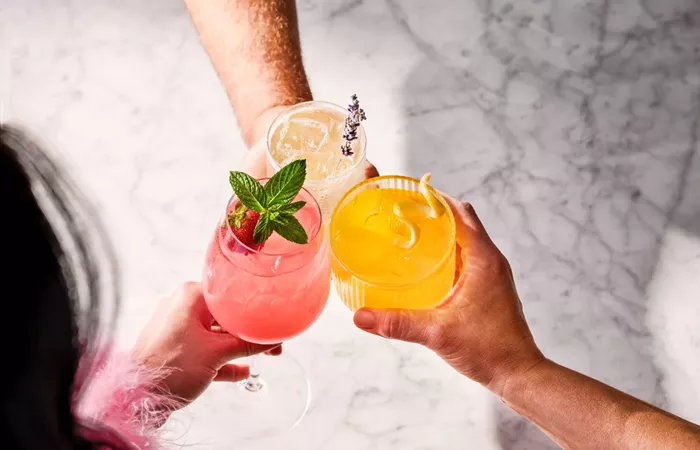
Several years into sobriety, Logan Denzer tried nonalcoholic beer and mocktails as a way to blend in at social gatherings where alcohol flowed freely.
“A lot of people feel out of place when everyone else is drinking,” said the 27-year-old Los Angeles resident. “For me, these beverages are an excellent solution.”
She is not alone. Millions of Americans — from people in recovery to those cutting back on drinking or abstaining altogether — are fueling a surge in demand for alcohol-free alternatives.
A Growing Industry
Retail sales of nonalcoholic beer, wine, and spirits reached $823 million last year, according to NielsenIQ. More than 90% of customers who buy them also purchase alcohol, suggesting many are using both.
Some consumers alternate between the two, a practice known as “zebra striping.” “They may have an alcoholic drink, then switch to a nonalcoholic option,” explained Marcos Salazar of the Adult Non-Alcoholic Beverage Association. “It can extend the night without overindulging.”
For Ann Kopp Mitchell, a retiree in San Diego, the strategy allows her to enjoy social drinking in moderation. “If I want a glass of wine with dinner, I don’t feel guilty. After that, I might switch to a nonalcoholic option and still keep the social pattern I enjoy,” she said.
While standard beer contains about 5% alcohol by volume, nonalcoholic drinks in the U.S. can contain up to 0.5% — roughly the same as a ripe banana. Many choose them when they want the taste of alcohol without intoxication, such as before driving or exercising.
Health Benefits — and Warnings
Public health experts welcome the trend. Studies consistently show that reducing or eliminating alcohol lowers risks for cancer, injuries, and other health problems. Dr. Joseph Lee, president of the Hazelden Betty Ford Foundation, called the spread of mocktails on restaurant menus a positive sign.
“These are really healthy things to see on a broader public health level,” said Lee, an addiction psychiatrist.
But experts caution that mocktails, especially those made with soda or sweet syrups, can pack high sugar levels. The American Heart Association recommends limiting added sugars to six teaspoons daily for women and nine for men, while a single 12-ounce soda often exceeds that.
Not for Everyone
For people with alcohol use disorder, nonalcoholic beverages can be a double-edged sword. Their look, taste, and smell mimic real alcohol, which can trigger cravings.
“They do contain a lot of alcohol-related cues,” said Molly Bowdring, a Stanford University researcher who has studied their use. “For some, they may actually lead back to drinking.”
Denzer remembers avoiding them early in recovery. “At first we thought, ‘This tastes like beer, and we’re only a year sober. That could make us relapse,’” she recalled. With time, she and others became more open, though she still advises caution for people newly sober or struggling.
Experts agree nonalcoholic beverages are better suited for those further along in recovery.
“Everyone’s journey is different,” Bowdring said. “It’s important to be mindful of how these drinks affect you personally.”
Lee emphasized that applies to anyone — not just people with a history of alcoholism. “What it comes down to is knowing yourself and your risks, the same way you’d assess family history for conditions like diabetes or cancer,” he said.
