
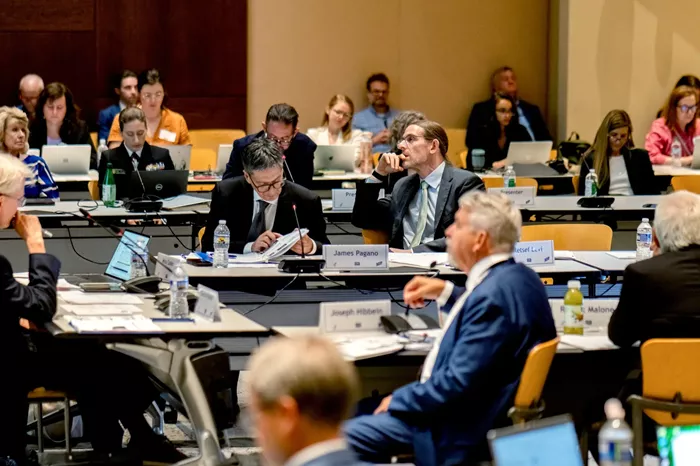
When Health Secretary Robert F. Kennedy Jr. dismissed all members of a key federal vaccine advisory committee earlier this summer, he claimed the group was “plagued with persistent conflicts of interest.”
But new research published Monday in JAMA challenges that assertion, finding that conflicts of interest among the two main U.S. vaccine advisory panels have been at record lows for nearly a decade.
Kennedy, who has long argued that government vaccine advisers maintain close ties with the pharmaceutical industry, told lawmakers at his January confirmation hearing that 97% of CDC vaccine advisers had conflicts.
Lead study author Genevieve Kanter, an associate professor of public policy at the University of Southern California, said the data does not support those claims.
“When I started looking at the vaccine data, I wasn’t really seeing those kinds of numbers,” Kanter said.
The study examined conflicts of interest from 2000 through 2024 among members of the CDC’s Advisory Committee on Immunization Practices (ACIP) and the FDA’s Vaccines and Related Biological Products Advisory Committee (VRBPAC). Both panels typically meet four times per year.
Researchers found that since 2016, just 6.2% of ACIP members and 1.9% of VRBPAC members reported any conflict of interest at a given meeting. The most concerning type — personal income from vaccine manufacturers through consulting, royalties, stocks, or ownership — has been virtually eliminated. Less than 1% of reported conflicts involved such financial ties.
By contrast, conflicts were significantly higher in the early 2000s, peaking at 43% for ACIP in 2000 and 27% for VRBPAC in 2007. Stricter disclosure rules and recusal requirements introduced after 2007 sharply reduced those figures. ACIP conflicts fell to about 5% by 2024, while VRBPAC’s remained below 4% since 2010, including multiple years with no conflicts reported.
“It’s a balancing act,” Kanter noted. “You want people who have done the clinical research on safety and efficacy, but it’s difficult to find top experts with no ties at all.”
Officials at the Department of Health and Human Services defended Kennedy’s actions, with spokesperson Andrew Nixon saying the secretary is committed to “eliminating both real and perceived conflicts to strengthen confidence in public health decisions.”
Still, vaccine policy experts expressed concern about Kennedy’s decision to dismiss the entire ACIP panel. Dorit Reiss, a professor at the University of California, San Francisco, warned that the move risks undermining scientific integrity.
“Anti-vaccine activists define conflicts differently than the rest of us,” Reiss said. “They believe even a government grant or work in a health care organization is a conflict.”
After dismissing 17 ACIP members, Kennedy appointed eight new members — several of whom are outspoken vaccine critics. One later withdrew, leaving seven. Some of the appointees have ties to anti-vaccine groups or have testified in vaccine-related lawsuits against manufacturers.
Georgetown University law professor Lawrence Gostin said Kennedy’s stated rationale was likely a “smoke screen.”
“Many, if not most, of the current ACIP members have been closely associated with anti-vaccine advocacy groups, including the one previously led by Kennedy,” Gostin said.
YOU MAY ALSO LIKE
New York Legionnaires’ Outbreak Claims Fourth Life, Over 100 Sickened
Appeals Court Restores Pregnant Worker Protections for Texas Employees
